


| Summary: This article explains the cost of Odoo implementation and provides realistic examples of Odoo implementation pricing for small, mid-sized, and large companies. It breaks down the main factors affecting Odoo ERP cost, including licenses, hosting, discovery, configuration, custom development, integrations, data migration, training, and support. Typical implementation budgets range from around $10,000–$15,000 for small companies to $40,000–$80,000 for mid-sized businesses and $150,000+ for large organizations. The article also explains why Odoo ERP pricing can vary significantly between providers and what businesses should compare when choosing an Odoo ERP implementation company. |
Imagine this scenario: You’ve received three commercial proposals for implementing Odoo for the same project, but the prices you see are completely different: $18,000, $60,000, and $150,000. And all of this is for the same company, the same ERP system, and, it would seem, the same requirements. Surely, the first figure seems suspiciously low to you, the second is more or less realistic, and the third looks quite inflated for reasons that are not yet clear. In this situation, it’s important to understand that none of these offers are necessarily incorrect or dishonest, since everything depends not so much on the ERP system itself as on what exactly the partner has included in the implementation cost. Key aspects here include the following: solution analysis and design, configuration, custom development, data migration, testing, project management, and user training. This article will be helpful if you want to understand what an Odoo implementation estimate actually consists of and why quotes for the same project can vary significantly.
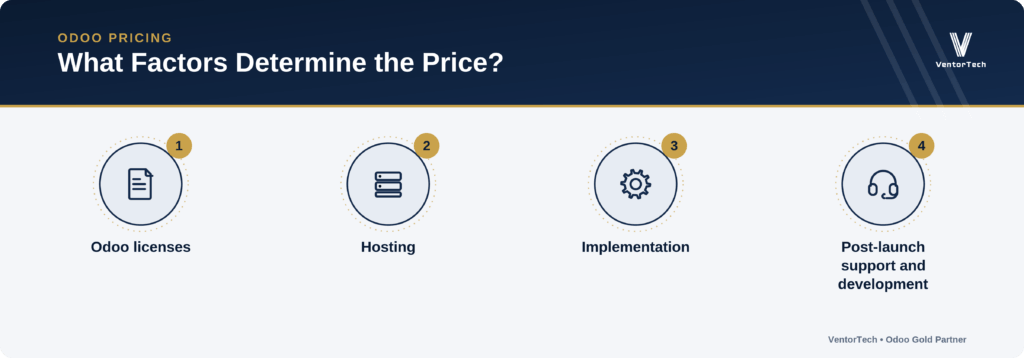
What Factors Determine the Price?
Odoo implementation pricing is a concern for anyone considering this solution, and it’s important to understand that it consists of two aspects: what you pay directly to Odoo, and what you pay to the implementation partner. We’ll now explain in more detail what factors influence the price and why they matter.
Odoo licenses
This is the portion of the cost for which you pay Odoo directly to use the software. It’s important to note that licenses are not included in the partner’s fee, and their cost depends on the feature set, the number of users, and the selected plan.
Hosting
Today, you have the possibility to choose from several Odoo hosting options. Depending on the project’s architecture, Odoo can run on Odoo Online, Odoo.sh, or on-premise. This aspect plays a major role in the total cost of ownership, where we see the true cost of Odoo ERP, but is not a key factor in implementation estimates.
Implementation
The implementation plan is the key component of the project budget and the biggest difference between partners’ proposals. The Odoo implementation steps included in an estimate can vary significantly depending on the complexity of your project. An Odoo ERP implementation company may include various aspects in its estimate, such as:
- Analysis and discovery: studying business processes and designing the future solution
- Configuration: tailoring Odoo’s functionality to all of your company’s processes
- Development: if the standard system lacks modules or functions necessary for your business, custom development may be required
- Data migration: transforming and transferring data from other systems
- Integrations: connecting marketplaces, banks, CRM, accounting systems, warehouses, and other services
- Training: sessions with employees and managers to ensure proper use of the system
- Go-live: specialists on standby during the first few days after the system’s official launch to promptly resolve any issues
Post-launch support and development
It’s important to understand that launch is not the final stage after which all expenses cease. You can pay separately for bug fixes, support, consulting, or even further development of your system.
When it comes specifically to comparing offers, an important point to note is that, more often than not, the difference in the cost of Odoo implementation is not due to difference in the partner’s hourly rates, as one might assume at first glance, but rather to the condition of the source data and the scope of custom development. In other words, two potential partners may have roughly the same rates, but they may allocate a completely different number of hours to the project for development, migration, and data preparation. This is precisely why offers from different potential partners often vary significantly.
Actual Ranges by Company Profile
Now let’s talk about realistic budgets. We’ve put together three typical company profiles to help you better understand what kind of budget range would be appropriate for your project.
A small company (about 12 users)
Here we’re talking about companies that are generally ready to make the most of Odoo’s standard feature set and don’t need custom modifications. In this case, the budget is approximately $10,000–$15,000 and may include basic process analytics, preparation and migration of necessary data, configuration of standard modules, basic testing, user training, and the system launch itself. It’s important to understand that if such a company requires numerous integrations or a significant amount of development work, this budget ceases to be realistic, since, in this case, the key factor is precisely the work performed according to the standard.
A medium-sized company (about 56 users)
This type company represents our average client profile for 2025, and the typical budget for Odoo implementation ranges from $40,000–$80,000. This budget includes not only the configuration of off-the-shelf modules but may also cover detailed discovery, data migration, configuration of several functional areas, custom development, integrations with other systems, testing, training, and go-live support. When it comes to the upper end of the range, it doesn’t necessarily mean that a partner simply offers more expensive services; rather, it’s usually an indication of a greater scope of work, such as more complex source data or a larger number of integrations.
A large company (about 300 users)
In a company of this size, Odoo is not just a system for a few key functions, but, without exaggeration, the central operational platform. In this case, Odoo ERP cost starts at $150,000, and, as in previous cases, final cost entirely depends on a variety of factors. In a company of this size, quality control, production, logistics, finance, procurement, planning, and integration create many more touchpoints that must not only be designed, but also configured and tested. It’s important to note that not every large-scale project will necessarily require such a budget, since everything depends not only on the number of users but also on the number of processes, integrations, legal entities, and the depth of customization.
Pre-implementation audit and discovery: Are they necessary?
Some companies view these aspects more as an additional formality than a necessity, but in some cases, they are critically important. Let’s break it down. First of all, a partner needs an additional audit and discovery phase before the main Odoo implementation if the company doesn’t have a sufficiently detailed scope. Specifically regarding VentorTech, this phase, including consulting, typically accounts for up to about 10% of the future project’s budget.
The importance of an audit and discovery process lies in the fact that the more complex the project, the more expensive it will be to correct a mistake made even before development begins. A high-quality discovery process allows you to precisely determine what can remain standard and in which areas customization is truly necessary. That is why, when assessing your budget, you should consider not only the number of users but also how closely your processes align with the Odoo standard. This explains why two companies of the same size may receive completely different cost estimates.
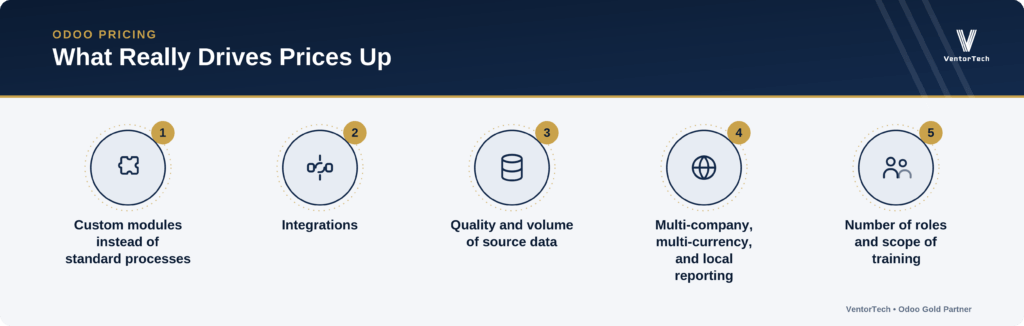
What Really Drives Prices Up
Custom modules instead of standard processes
Odoo already covers a significant portion of typical business scenarios, and configuring a standard workflow is usually less expensive than developing a new one.
Integrations
To configure integrations effectively, it’s important to determine what data is transferred between systems, which system serves as a single source of truth for orders, products, and inventory levels, and how errors are handled. After that, this data exchange must be developed, tested, and maintained.
Quality and volume of source data
It’s important to understand that migrating 100,000 clean records can be much simpler and faster than migrating 20,000 records with varying product names, duplicates, incomplete attributes, and missing units of measure. Here, the cost is not associated with loading data into Odoo, but rather with analyzing, cleaning, mapping, transforming, and performing repeated test migrations.
Multi-company, multi-currency, and local reporting
If the database handles multiple legal entities, countries, and currencies, it’s important to configure separate financial structures, access rights, taxes, consolidation, and intercompany flows. Odoo supports multi-company and multi-currency functionality, but each additional aspect means more scenarios to configure and test.
Number of roles and scope of training
A group of users who work in roughly the same way and a group of users with different roles represent projects of vastly different complexity. The more roles and processes there are, the more time is required for training, documentation, and go-live preparation.
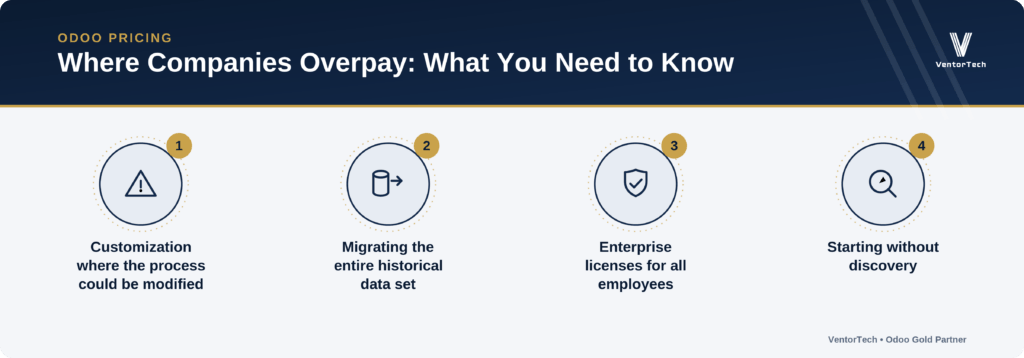
Where Companies Overpay: What You Need to Know
Sometimes a high project budget doesn’t necessarily mean that a company is overpaying; after all, it may simply be a necessity. Let’s take a look at the situations in which overpayment does occur and how this could have been avoided.
Customization where the process could be modified
This refers to attempts to replicate every detail of the old ERP system or Excel process flows in Odoo. It may seem like this would be easier, but in reality, the partner will have to develop and test additional code. To avoid this, it’s best to verify before development whether a non-standard feature truly adds business value.
Migrating the entire historical data set
This is a common mistake, and it’s important to understand that old orders, duplicate customer records, archived records, or obsolete products are not necessary for day-to-day operations. Each additional dataset must not only be cleaned but also restructured to match the Odoo schema, transformed, imported, and verified. To avoid this, it’s important to determine which data will actually be needed after go-live.
Enterprise licenses for all employees
Not every employee in a company needs the same level of access as a sales manager or an accountant. One of Odoo’s advantages is that it offers different user types and access levels, as well as the ability to customize permissions based on role; Odoo Enterprise license pricing depends on these factors. It’s best to create a list of roles and usage scenarios before purchasing licenses to avoid overpaying.
Starting without discovery
This is one of the most costly mistakes, because in such cases, the estimate is based on guesswork and grows as the project progresses; every new clarification results in additional work hours. Odoo discovery phase allows for defining the processes, integrations, and the scope of customization in advance, which significantly reduces additional costs that arise during the project.
How to Get Comparable Offers
If you simply start comparing commercial proposals based on the final price, that would be a huge mistake. For example, if one partner includes migration and integration in the fixed price, while another leaves these procedures out of the estimate, then comparing prices won’t yield any meaningful results. To ensure that your comparison is accurate and informative, it’s important to break down each offer by structure, and you should feel free to ask your potential partners to provide you with the necessary information.
The structure could be as follows:
- Processes in the scope: all processes and modules included in the project must be specified clearly
- Custom developments: each non-standard modification should be listed as a separate item and include a brief description and cost estimate
- Data migration: information on exactly what data will be migrated and in what volume, as well as who is responsible for preparing it
- Training: a fixed number of hours or sessions, as well as user roles and the number of groups
- Go-live and support: specific actions to be taken by the partner during the launch as well as the duration and scope of the support period
- Ownership of the code: identification of the owner of custom developments created as a part of the project, and the terms for modifying them
This structure will help you get comparable offers and understand exactly how the estimates are calculated. As experience shows, the cheapest offer usually has a narrower scope, while the most expensive one includes work that the other two companies didn’t include in the budget.
Final Thoughts
As you can see, Odoo ERP pricing cannot be determined solely by a price list or the number of users in your company. The figures we’ve provided as examples in this article are merely rough guidelines, since the actual budget is determined by processes, integrations, customization, data, and launch requirements. If you realize that your company needs an assessment, don’t assume you’ll have to go through a full discovery process right away. To start, a high-level estimate will suffice, and for this, you’ll need to describe your company, key processes, the number of users, and the systems with which Odoo needs to be integrated. VentorTech offers the opportunity to get such an estimate for free by filling out the estimate request form. This step will give you a realistic budget estimate even before you present it to your board of directors.
Get a High-Level Odoo Cost Estimate
Need a number for your specific case? Start with a free high-level estimate. Tell us a bit about your project, and we’ll give you an initial cost range.
Recommended articles:
- Odoo ERP for a Growing Nutrition and Supplements (Nutraceuticals) SMBs
- What Nutrition Manufacturers Actually Want from Their Software
- Why Odoo Works for Thousands but Failed for You? The Hidden Truth Behind Odoo Complaints
- How to Calculate Odoo Workers for Demanding Systems
- Odoo Implementation Steps
- Odoo Access Rights Structure
- AI Order Processing in Odoo
- Odoo EDI Integration
- Key Performance Indicators (KPIs) and their Role in Successful ERP Implementation
- 10 most common questions to the official Odoo partner

----------------------------------------------------------------------
Education: Bachelor's degree.
----------------------------------------------------------------------
Experience:
Marketing manager
VentorTech
----------------------------------------------------------------------
Current position: Marketing manager VentorTech
----------------------------------------------------------------------
B2B Marketing
Google Tag Manager and GA
0 Comments