| Summary: Should you buy Odoo directly or go through a partner? It comes down to how complex your business is and where it’s headed, not just the price tag. Going direct is cheaper and quicker to start, but your own team ends up doing the process mapping, data migration and project management. A partner costs more upfront but brings people who’ve done this many times before and know where projects tend to go wrong. If you’re a small team of 1–5 users running simple, standard processes and you have someone technical in-house, going direct usually works. But if you have 25+ users (or will within a couple of years), several departments, compliance requirements, a migration from something like QuickBooks, or integrations with e-commerce or logistics tools, a partner will save you a lot of pain. There’s a reason more than 80% of larger Odoo projects in Europe go through partners. Read on to learn which path is right for your business, and use our quick checklist at the end to check your own situation. |
Anyone entertaining an Odoo implementation eventually runs into the same fork in the road: buy directly from Odoo SA, or go through a certified implementation partner? The instinct for many small or budget-conscious businesses is to assume “direct” is easier and cheaper, while “partner” sounds like an unnecessary markup. And many lack awareness of the second option altogether, so the first Odoo implementation encounter for them is not even the fork. Here’s where the story becomes even more nuanced, and it shows through the pattern of complaints and successes littering Reddit, Trustpilot, and the BBB. This article breaks down where each path tends to either work or fail, and how to decide which one fits your situation; we’ll even give you a quick cheat sheet at the end.
Setting Expectations: working with a Partner vs. going Direct
Going direct with Odoo SA typically means Odoo Online/Enterprise licensing, access to documentation, community forums, and, if you buy a support package, a you’ll also get a “Success Pack” and a Business Success Analyst (BSA). It’s critical to understand what that BSA relationship actually is: knowledge transfer and coaching, not hands-on implementation delivery. Odoo SA’s own positioning is explicit that Success Packs ‘enable’ success rather than deliver it. If you’re expecting someone to build your system for you, going direct will disappoint you. That isn’t Odoo SA doing a bad job. It’s just not the service being sold.
Working with a certified partner can shift your model entirely. A partner brings functional consultants who understand business processes, technical staff who handle customizations and integrations. Just as important, a partner can advise on other aspects of running the implementation as a business transformation project (with a timeline, scope, and defined risk) and not as a software installation on someone’s PC done by the technically savvy owner’s nephew. A good partner will challenge your customization requests rather than rubber-stamping them, push back on unrealistic go-live timelines, and provide governance around configuration rather than just code-level changes.
The trade-off is straightforward: direct is cheaper upfront and faster to start, but places the entire burden of process mapping, requirements gathering, and project discipline on your internal team. Partner-led is a larger upfront investment but transfers implementation risk to people who do this for living and have seen the failure modes before.
Common misconceptions about Odoo SA’s Role vs. the Partner’s
The single most damaging misconception is treating Odoo like shrink-wrapped software that you install over a weekend rather than an enterprise-transforming project. Odoo’s accessible pricing, starting around $25/user/month, a tiny fraction of what, for example, SAP S/4HANA implementations cost, creates a false signal that implementation complexity scales with price. It doesn’t. ERP complexity (process standardization, data migration, change management, integrations, user adoption) is largely constant, regardless of which tier of software you buy.
A second misconception is confusing Odoo SA’s support function with implementation consulting. When users complain that “the only support I have is a business manager I have to pay to speak with,” they’re often describing exactly what was sold to them: coaching, not outsourced execution. (We discuss more on that in this article). Odoo’s support model is built around teaching customers to configure their own system, not on fielding “can we have this button” requests. That’s not a flaw; it’s akin to how a car manufacturer expects you to go to a dealership, not corporate headquarters, when you need service.
A third misconception, and this one is aimed at partners rather than Odoo SA, is that flexibility equals safety. Odoo’s architecture allows deep customization, but that doesn’t mean every request should be built. Partners who say ‘yes’ to everything are optimizing for billable hours, not for your upgrade path five years from now. The businesses that get burned by “20,000x more complicated than it needs to be” reviews are usually the ones that skipped structured discovery, did not distinguish configuration from customization, and bought based on a sales pitch instead of a test drive.
What others are doing?
Many companies start direct or with a freelancer at small scale, then bring in a partner as they cross into the 25+ or 50+ user tier. The risk with this approach is technical debt: informal early customizations, done without governance, can make the eventual partner engagement more expensive than starting with structured support would have been. Many if not most of those transitions are, in fact, rescue missions that save Odoo implementations gone wrong to one degree or another.
The deployment data agrees with that scenario. The European market, for example, shows a clear structural pattern: the bigger the deployment, the more it runs through a partner. For deals of 50+ users, more than 80% go through implementation partners. Small deployments (1–5 users, which some modeling suggests make up roughly 82% of all new sales) are increasingly self-service or lightly assisted – territory in which going direct, or working with a freelancer, is common and often reasonable. Large deployments remain partner-dependent, because the complexities, integration surfaces, and business risks at that scale simply don’t tolerate a DIY approach.
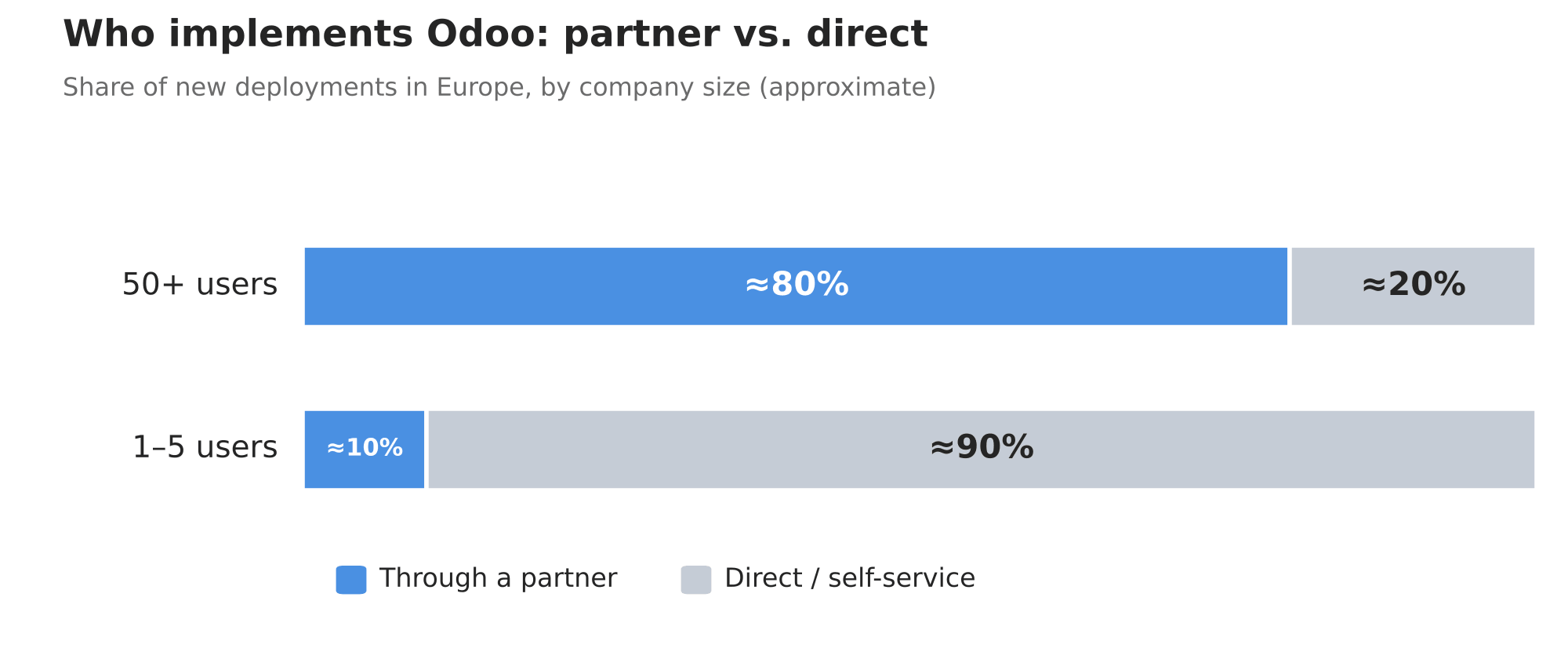
One caveat matters here: A snapshot of “5 users” doesn’t mean that a company will continue to be a 5-user shop. A business that starts with a partner-light, direct deployment at 5 users could easily be a 30-user partner-managed account within two years. That expansion trajectory is arguably more important to your decision than your current headcount.
This dynamic also reflects on how Odoo SA is marketing its ERP: it’s attractive, fast, easy, and free to begin with product. Once Odoo has its foot in your door, and you want more from it, complexity increases exponentially, and that initial shaky foundation without a forward-looking approach often bites back. Many complaints about Odoo actually reflect on how people got misled by the marketing of Odoo’s ‘simplicity’ and then ran into all the intricacies of ERP implementation that are contingent on business complexities rather than having much to do with software.
Our European data also hints at a pattern of partner share falling while small deployments grow. While this trend is due to many reasons, including the ever-improving ease with which you can bring any software and Odoo in particular in house, the rise of AI as a “free coder” likely contributes to such misunderstandings and negative results.
Nowadays, anyone can become a programmer by merely prompting chatbots to write a customization. Direct implementers can go on for a while before hitting a wall, but then they hit a harder wall later on: unclear processes, ungoverned data, and upgrade debt. In this scenario, “can we have this button” costs an AI prompt instead of a quote (sure, huge savings!) The resulting code, however, has no recorded intent, no tests, and no one who can explain it; the model might write for an older Odoo version, creating deprecated API debt that shows at the next upgrade. That reliance on older versions, including documentation, is a very serious caveat caused by the statistical nature of AI. And dangerously, the technical debt grows exponentially with those quick and dirty results.
Partners also use AI as an assistant-coder, but that is done for efficiency when coding is already justified through process re-engineering and data governance efforts. AI can also be used effectively to scan custom modules for breaking changes, which targets bad customizations, or to generate the documentation and tests, still under expert human supervision.
How do you decide?
The direct-versus-partner decision isn’t really about Odoo’s pricing tier or brand reputation, it’s about matching implementation support to organizational complexity and risk tolerance. So, your decision cheat sheet should look something like this:
Lean Direct when:
- You’re planning on a small team (roughly 1–5 users) to deploy simple, standard processes
- Your business is single-application and low-risk (e.g., just invoicing or basic CRM)
- You have in-house technical capacity comfortable with self-configuration
- You’re not integrating with legacy systems or complex third-party tools
- Budget constraints outweigh the value of hands-on project management
Lean Partner when:
- You’re at or approaching 25+ users, or expect to scale there within 1–2 years
- Your business spans multiple departments requiring cross-functional process design
- You operate in a regulated industry (including finance, manufacturing, or distribution) with heavy compliance requirements
- You need data migration from legacy ERP/accounting systems (like QuickBooks)
- You lack expertise in running similar projects or resources to drive discovery and adoption
- You’re planning integrations with external systems (such as e-commerce, logistics, or taxation)
But here comes the rub: evaluating your own capabilities, and especially projecting those into the future, is a valuable capability by its own right, which you might not have and likely won’t know if you don’t. It’s a catch-22 that is resolvable by inviting someone in from the outside. Obviously, consulting with an Odoo partner is the first thing that comes to mind, but that puts them in a conflict-of-interest situation. There are advisors like Gartner (expensive for enterprises) or InfoTech Research Group (more affordable, targeting smaller businesses) who do such “maturity assessments” independently and neutrally or can offer a methodological framework for a DIY plan.
The businesses that end up disappointed along whichever path they choose are almost always the ones that misunderstood what they were buying. They treated a BSA relationship as outsourced delivery, or treating a partner as a vendor to blindly trust rather than a strategic collaborator to actively manage.
Get the model right for your size and trajectory and choose the path.
Odoo Direct or Odoo Partner: not sure which path fits your business?
VentorTech is an Odoo Gold Partner that helps companies across Europe plan, implement and rescue Odoo projects. Tell us about your project, and we’ll give you an honest recommendation, even if that means going direct.
Recommended articles:
- Successfully Migrating from QuickBooks to Odoo ERP: Key Insights and Best Practices
- Why Odoo Works for Thousands but Failed for You? The Hidden Truth Behind Odoo Complaints
- How to Calculate Odoo Workers for Demanding Systems
- Odoo Implementation Steps
- Odoo Access Rights Structure
- AI Order Processing in Odoo
- Odoo EDI Integration
- Key Performance Indicators (KPIs) and their Role in Successful ERP Implementation
- 10 most common questions to the official Odoo partner
Image by rawpixel.com on Magnific
Image by magnific

----------------------------------------------------------------------
Education: MSc, MBA
----------------------------------------------------------------------
Experience:
Director, Research & AdvisoryDirector, Research & Advisory
Info-Tech Research Group
Global IT Director, CIOGlobal IT Director, CIO
Napoleon Group of Companies
----------------------------------------------------------------------
Will do any work for SpaceX for free