


| Summary: Article is about Odoo ERP for SME companies. Main points: SMEs choose Odoo to reduce fragmented tools, automate routine tasks, improve transparency, protect data, and get real-time analytics. Common implementation problems include poor planning, technical issues with integrations and data migration, excessive customization, employee resistance, lack of training, and choosing the wrong implementation partner. The article recommends analyzing business processes before starting, setting clear goals, choosing an experienced Odoo partner, training the team, and planning the budget with a 15-30% reserve. |
The modern business environment is characterized by high competition and constantly changing consumer demands. Accordingly, small and medium-sized enterprises are constantly searching for new and effective ways to improve their operations and gain a competitive advantage. One of the most effective solutions today is the implementation of an ERP system, as it leads to the optimization and automation of most processes, increased customer satisfaction, and greater profits.
There is a huge selection of ERP systems on the market today, but most companies trust their processes to the Odoo system. Due to its modularity, flexibility in customization to specific business needs, and intuitive interface, Odoo is an excellent alternative to outdated or limited systems and is capable of meeting all the needs of an enterprise. However, it is important to understand that the implementation of any ERP system, including Odoo, is a complex and responsible process during which difficulties may arise, and this is completely normal. In this article, we will discuss the most common challenges when implementing Odoo, as well as share tips on how to avoid them.
Why SME Companies Are Increasingly Choosing ERP Systems
Digital transformation of small and medium-sized businesses is no longer a competitive advantage, but a prerequisite for a company’s success. The introduction of digital technologies allows for significant improvement in business processes, customer interaction, and increased competitiveness.
An ERP system is necessary for SME companies for several reasons, including:
- Elimination of departmental fragmentation
- Routine task automations
- Process transparency
- High level of protection for confidential information
- Real-time analytics
Odoo solutions are ideal for every business, as after Odoo ERP implementation, the company receives a comprehensive open source system that integrates all business processes into a single environment. Odoo ERP for SMEs provides a user-friendly interface and allows them to easily customize the system to their individual needs.
In addition, Odoo is easily scalable and grows with a business, requiring no major changes when the number of users or data volume increases. Today, Odoo is one of the fastest-growing ERP systems and is increasingly becoming the choice of many companies. Below, we describe the key challenges to be aware of when implementing Odoo.
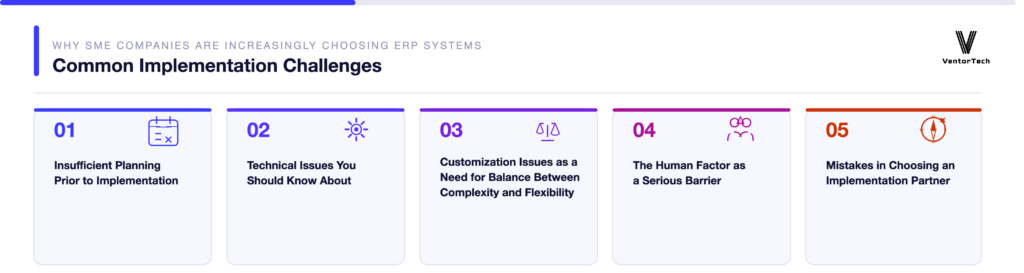
#1. Insufficient Planning Prior to Implementation
Implementing Odoo is a long and complex process that requires careful preparation. When an SME company plans implementation without accurately defined goals, results often include missed deadlines, user resistance, and cost overruns. The consequences of insufficient planning are serious, and they affect not only the Odoo implementation process itself, but also the success of the company and customer satisfaction in the future.
In addition, the Odoo system itself is highly flexible, which is its huge advantage; however, without sufficient planning, this can quickly turn into a disadvantage. As a rule, companies that do not have clear business goals for their Odoo project cannot cope well with functionality, which leads to wrong configuration, reduced performance, and data integration difficulties. These serious challenges lead to increased costs and failure.
#2. Technical Issues You Should Know About
Odoo solutions implementation is a technically complex process, and therefore, technical difficulties may arise. For example, integration with existing systems, such as CRM, warehouse management, or accounting software, can be problematic. Often, without technical expertise and a robust implementation strategy, connecting these systems to Odoo becomes an extremely complex task.
Another technical problem is data migration. For example, transferring data from old systems can be difficult due to errors in the data structure. In addition, sometimes it happens that some information is lost during transfer, which can complicate the work. Infrastructure issues are another common challenge when implementing Odoo ERP for SMEs, as companies have to decide which solution they need, cloud or on-premise, and which modules to connect first.
#3. Customization Issues as a Need for Balance Between Complexity and Flexibility
The ability to customize and configure the system to meet specific company requirements is a huge advantage of Odoo. This results in high performance and management transparency. For example, the possibility to connect only necessary modules allows you to create a customized solution without unnecessary functions. However, there is always a risk of excessive customization if the company cannot accurately assess its goals and needs. Excessive customization often leads to a loss of flexibility, conflicts with new functionality, and increased risk of failure, complicating the system and making it fragile.
In addition to risks of excessive customization, other problems may arise. For example, custom solutions require additional resources for creation and further maintenance. This means that SME companies must be prepared to spend money on development and support. Furthermore, custom solutions are quite specific, as they are developed for the specific needs of a company and are not further developed on their own. When updating standard software, custom modules may require adaptation.
A common mistake that hinders implementation is that companies try to adapt Odoo to their old business processes and do not use a conscientious approach to adapt to the system’s best practices.
#4. How Employee Resistance Affects Odoo Implementation
Personnel are an important component of every business, and no matter how perfectly people perform their work, they tend to succumb to emotions and become accustomed to processes. It is the human factor that often becomes a real challenge when introducing new tools or transitioning to Odoo solutions. This manifests itself in a lack of training, resistance to change, and maintaining outdated working habits. If staff are unwilling to adapt to new processes and have low motivation, the effectiveness of implementation decreases, which has a negative impact on the company’s overall success.
Employees feel confident in the old, albeit inefficient, system, while Odoo requires them to change their habits. In addition, they are afraid to show their incompetence in working with new functionalities and often do not understand the personal benefits of automation and process optimization.
Another problem associated with Odoo implementation is insufficient staff training, which leads to incorrect data entry that negates the system’s advantages. Such incompetence on the part of employees significantly slows down work processes instead of speeding them up.
#5. How to Choose the Right Odoo Implementation Partner
Since Odoo is a comprehensive solution that fully covers the needs of SME businesses, its implementation is a rather complex and time-consuming process that requires careful preparation. Some companies undertake implementation on their own, but most fail to see it through to the end for achieving all of their implementation goals. On the other hand, partners provide qualified implementation and help to transfer data efficiently, which avoids critical errors.
However, choosing a reliable partner is also a difficult task, because the success of your entire process depends on it. The main mistake companies make when choosing a partner is that the partner lacks industry expertise. If they do not understand the specifics of your business, this will most likely lead to incorrect modular configurations.
Another serious problem is the lack of post-implementation support. If an Odoo partner disappears after launch, then the company is left alone with all the questions, bugs, and untrained staff. In such cases, many companies turn to an experienced third-party team for Odoo project rescue and stabilization to get their implementation back on track. Such a partner also does not ask additional questions during consultations and instead offers standard solutions for business processes that do not quite fit the specifics of the task.
Effective Tips on How SME Companies Can Avoid Most of the Above Problems
As you can see, implementing a multifunctional system such as Odoo often comes with challenges and problems, which is perfectly normal, as each case is unique. The main causes of problems are often the lack of a clear plan, employee resistance, underestimating the complexity, and unrealistic expectations. Although such realities may seem very difficult and even discourage you from implementing the system, we assure you that most of these problems can be avoided, and now we will share tips on how to do so.
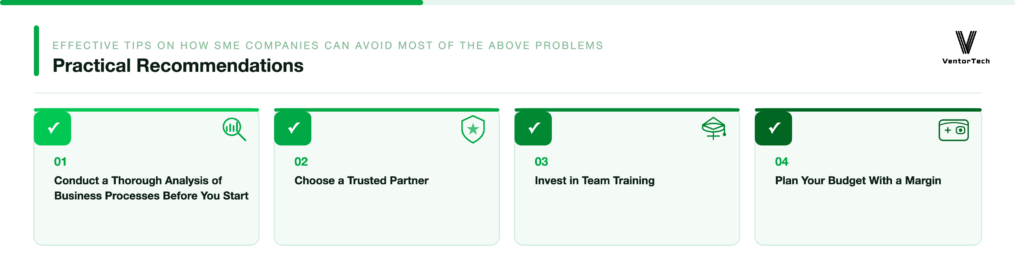
Conduct a Thorough Analysis of Business Processes Before You Start
First, record current processes and understand which ones need to be improved. You also need to set clear goals, as this will help you understand which functions are essential while avoiding unnecessary costs.
Choose a Trusted Partner
Be sure to pay attention to the partner’s portfolio and experience in this field. For example, many SME companies trust the VentorTech team with Odoo implementation. As one of the most experienced Odoo partners worldwide, VentorTech helps mid-size and enterprise companies automate and scale their operations. We have been working with Odoo implementations since 2012 and have a large number of successful stories.
Invest in Team Training
Preparing employees to work in the new system is the key to a successful transition and minimizing resistance. Proactively, you can organize practical classes, workshops, and training sessions on Odoo modules. In addition, some implementation partners provide useful training materials that help employees understand how everything works.
Plan Your Budget With a Margin
This is critically important, especially for SMEs, as the actual cost of such projects usually differs from initial estimates. When planning, accounting for all nuances that may arise, such as performance optimization, functionality improvements, or additional integrations, can be difficult. To avoid unpleasant experiences, experts advise adding a 15–30% reserve to the initial implementation budget.
Is Your Odoo Implementation Struggling?
Whether you’re just starting or dealing with a failed rollout – our team will review your situation and suggest the fastest path forward
Conclusion
The Odoo system is a cutting-edge solution that can meet the needs of workflow automation for businesses of any size. It includes a CRM system, inventory, accounting, e-commerce module, electronic signature, digital marketing modules, HR process optimization solutions, and much more. However, it is important to understand that it is not a magic wand that will do everything on its own, and the success of implementation largely depends on the preparation of the company itself and the actions of the implementation partner. The problems we have described in this article are most often caused not by the system itself, but by improper project management, while with the right approach, SMEs can reap enormous benefits.
Set precise and realistic goals, choose a reliable implementation partner, and train your team, and then the Odoo implementation will be successful. If you have any questions, contact us right now and get the best advice for your specific business situation!
Recommended articles:
- Why Odoo Works for Thousands but Failed for You? The Hidden Truth Behind Odoo Complaints
- Will your Odoo Enterprise contract be surcharged 25% in April? Tricky cases explained…
- How to Calculate Odoo Workers for Demanding Systems
- Odoo Implementation Steps
- Odoo Access Rights Structure
- AI Order Processing in Odoo
- Odoo EDI Integration
- Key Performance Indicators (KPIs) and their Role in Successful ERP Implementation
- 10 most common questions to the official Odoo partner

----------------------------------------------------------------------
Education: Bachelor's degree.
----------------------------------------------------------------------
Experience:
Marketing manager
VentorTech
----------------------------------------------------------------------
Current position: Marketing manager VentorTech
----------------------------------------------------------------------
B2B Marketing
Google Tag Manager and GA

0 Comments