

| Summary: The article argues that AI in Odoo and other ERP systems will transform how people work, but it will not replace ERP itself. AI agents can automate repetitive tasks and improve efficiency, yet they still rely on Odoo as the central system of record for clean data, financial transactions, compliance, integrations, and business processes. In this sense, AI in Odoo makes ERP even more valuable, because autonomous agents need a stable and well-structured operational foundation to function effectively. |
The panic that shook Wall Street
In February 2026, roughly $285 billion vanished from SaaS (Software as a Service) company valuations in about 48 hours. The catalyst was Anthropic’s launch of Claude Cowork — a product that demonstrated AI agents performing sustained, autonomous knowledge work. Traders coined a name for it: SaaSpocalypse, for the sudden investor fear that AI “agents” would hollow out traditional SaaS by performing the work inside apps like ERP much better than humans, which will shrink the numbers of current license subscriptions, thus undercutting SaaS revenue. That fear, technically, should not have spread only across SaaS but any software that depends on “per-seat” economy, yet SaaS was alleged to be affected immediately and most acutely.
Narratives that land loudly, however, are not always the ones that land accurately. For anyone thinking that ERP systems like Odoo are on their death row, the distinction matters. We have been here before. The media just called it something different.
Two very different AIs in the room
Before asking whether ERP is dying, it helps to recognize that the “AI” label is used quite frivolously in general, as this term used in the ERP field is doing double duty for two fundamentally different things, which causes confusion.
The first application of the term “AI” is utilized as a business intelligence layer: models that sort your data and help make sense of it. Those tools allow ERPs like Odoo to recognize historical demand patterns, estimate lead times, and offer stock movement trends, etc. Natural language queries against your ERP database facilitated by LLM integration serve as a “smart” add-on to that intelligence, which Odoo also adopted with configurable AI agents that can answer questions, summarize records, and navigate databases in natural language.
Related article: AI Order Processing in OdooThese functions are valuable but not new; they are the extension of reports and analytics that have existed for decades. The problem runs straight into a classic issue: garbage in, garbage out. AI layered atop chaotic data produces faster chaos, not insight. And the pure quality of your ERP’s underlying data has nothing to do with AI.
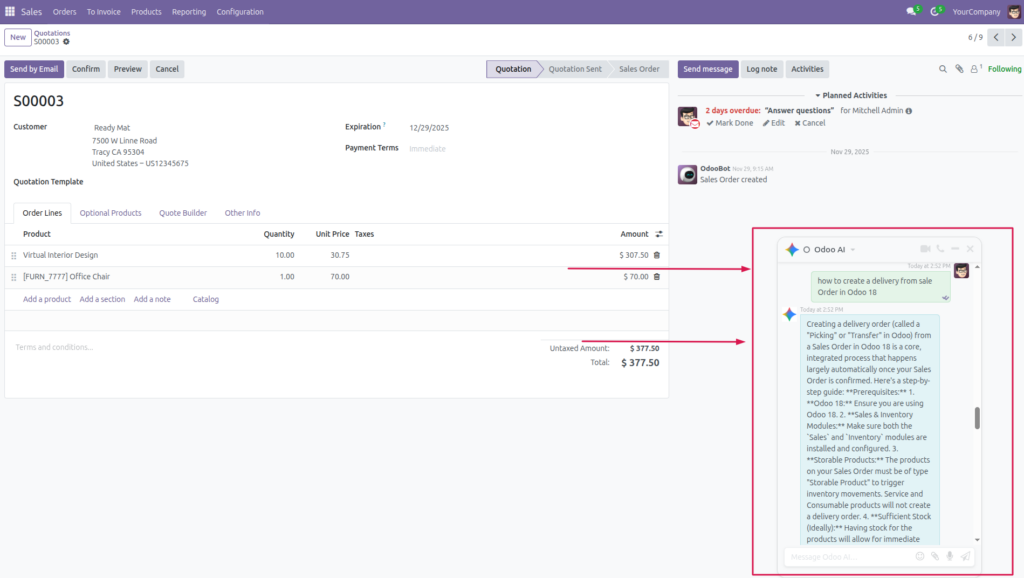
The second application is different: AI as an autonomous agent, one that does not just analyze but executes. It no longer simply assists and informs, but now AI executes the work and the human provides oversight (in the best-case scenarios). This is what Claude Cowork actually demonstrated. Running locally on a user’s computer, it can read, create, and edit files, and carry out multi-step tasks such as organizing documents, analyzing data, and automating workflows — functioning as a “worker” that takes ownership of routine but time-consuming work rather than just responding to prompts.
It is this second application — the agent-centered one (as in, agentic AI) — that triggered the SaaSpocalypse. And this is where both genuine excitement and attentive caution are warranted. Because the agentic promise sounds, to anyone who was paying attention between 2015 and 2022, remarkably familiar.
We’ve seen this movie before with RPA starring
Before LLM agents, there was Robotic Process Automation (RPA) — software that mimicked human actions inside business systems (i.e., clicking buttons, copying fields, and navigating screens in a scripted way) to reduce manual effort, and therefore, headcount. By 2022, 85% of large organizations had deployed RPA somewhere within their organizations while expecting “transformation.” The outcome reality: 30–50% of RPA projects outright failed, and only 3% of organizations ever scaled their changes enterprise-wide.
Agentic LLM and RPA share the same goal but operate on different principles. RPA encodes steps and is very fragile. Agentic LLM is more resilient, because it encodes intent. In such a system, every click does not need its own script — instead, you describe a goal, and the agent “reasons” about how to achieve it, reads unstructured inputs (such as an email, a PDF contract, or a verbal instruction), and adapts when something unexpected appears.
The RPA fragility led to high setup costs, unreliable execution, and burdensome maintenance, where each system update, each screen redesign, and each renamed form field became a potential outage for every bot that touched it. An LLM-based agent overcomes RPA brittleness and setup complexity but then also introduces its own risks.
In all, RPA serves as just another history lesson — a cautionary tale on how the adoption curve will not be as clean as the demos suggest. Agentic LLM is meaningfully better than RPA with lower setup costs, higher adaptability, and far broader applicability. However, the organizations that expect transformation in 12 months are likely to find themselves managing the same gap between demo and production that RPA showed.
Four reasons ERP is NOT dying
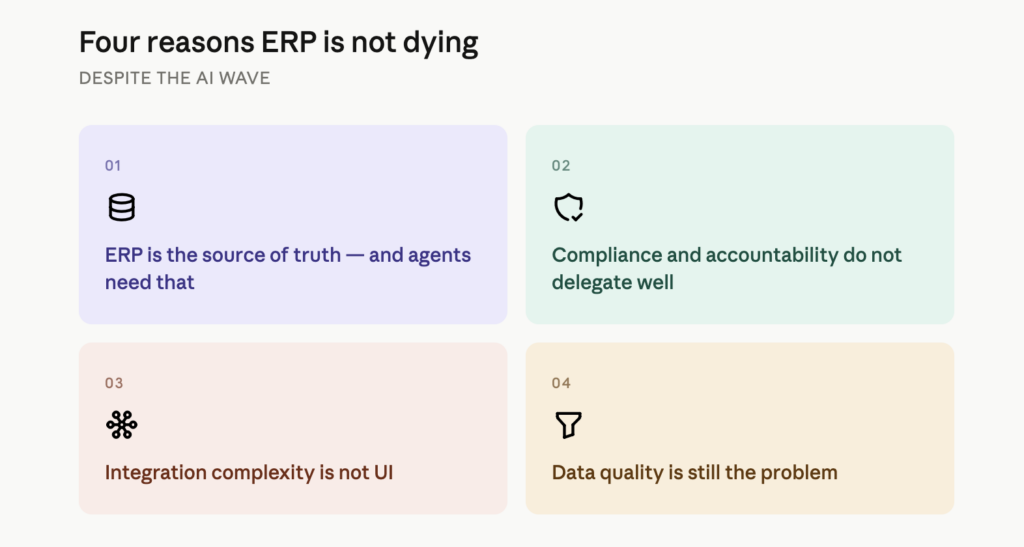
1. ERP Is the source of truth — and agents need that
While the per-seat business model might be dying, the ERP systems themselves are becoming more critical as ”systems of record.”
ERP is the language and fabric of the enterprise, enabling auditability, semantic, and data context. AI consumes and infers from data; it is not the data itself. An AI agent that books a purchase order, processes an invoice, or creates a customer record needs somewhere to write that transaction permanently, consistently, and in a format that auditors, tax authorities, and future systems can trust. That place is the ERP. ERP remains essential wherever it is the “source of truth” for money, inventory, or risk, and where errors create real financial consequences.
For Odoo specifically, this is a genuine structural advantage. Its breadth — spanning CRM, inventory, accounting, and manufacturing in a single integrated system — means that it serves as the connective tissue across business domains. An agent operating in sales still needs to write to the same ledger as the agent operating in procurement. Odoo holds that ledger.
2. Compliance and accountability do not delegate well
AI independent execution changes accountability models by breaking down traditional approval chains. Tax filings, audit trails, revenue recognition, regulatory compliance — these require not only correct outcomes, but traceable ones. The question “who approved this?” must have a human answer somewhere in the chain. Regulatory frameworks have not caught up with autonomous agents, and “who is liable” remains an open and unresolved question.
This might be a temporary gap — subject to changes in how legal and financial accountability work (similar problem, for example, as introduced by self-driving vehicles). This question keeps ERP firmly in the loop for any transaction that carries legal weight.
3. Integration complexity is not UI (user interface)
ERP systems are notoriously hard to rip out, because they are woven into everything else: banking integrations, tax reporting systems, warehousing APIs, payroll engines, customs brokers, etc. For Odoo’s SMB customers, this integration layer represents years of configuration, custom development, and institutional knowledge.
AI agents only chip away at UI-heavy tasks. Odoo’s per-user pricing model faces genuine pressure from agents that reduce the number of humans doing repetitive ERP tasks, but the underlying platform with its integrations, data model, and compliance logic is not something an agent layer makes obsolete.
If anything, well-designed APIs make Odoo more attractive as the backend for agentic workflows, not less.
4. Data quality is still the problem
This echoes AI application in business intelligence but from a different angle. LLM is unpredictable when it comes to handling exceptions: It is not driven by logic but instead by fuzzy statistical patterns acquired from massive data and hence represents the average (i.e., standard) approach to its operational execution. If your current environment is riddled with exceptions and manual runarounds, handing them over to an AI agent might be risky: When faced with ambiguity, for example, instead of “throwing a towel,” an AI agent might hallucinate by masking the issue and allowing errors to accumulate into a massive disaster.
This means that companies invested in clean, well-governed Odoo implementations are actually better positioned to benefit from agentic AI — while those who deferred the boring work of data hygiene will find that AI exposes and accelerates their messes. For Odoo partners and implementers, this means that rigorous ERP implementation is not just good practice, it is the prerequisite for the AI era.
Related Service: Odoo DevelopmentActual changes are needed in the interface and clerical layer
The clerical layer that sits over ERP workflows is genuinely vulnerable. For Odoo’s per-user licensing model, this creates real pressure: If ten users had handled tasks that five can now handle with AI assistance, the seat count falls. But will it actually cause revenue loss or merely a change in the pricing model? This is a question not just for Odoo or ERPs but also for the SaaS stack of apps that was hit by the SaaSpocalypse. The price and revenue are driven by the number of licenses only superficially, and this isn’t the only licensing mode. For example, charging for transactions is becoming increasingly popular, which reflect the application use (and hence value) more objectively.
The true driver of revenue-to-price is the value proposition and the competition within the market. And for that market, AI adds genuine value as an accelerator — faster onboarding, smarter forecasting, and automated routine correspondence alongside the unified, governed system of record. As a result, an ERP only benefits from such an accelerator as its value goes up.
On top of that, Odoo’s SMB customer base lives in a different world from the enterprise. A 50-person manufacturer or a regional distributor is not worried about AI replacing its three-person accounting team; it is trying to get those three people to stop doing things twice in two different systems.
Skip the hype, build the foundation
The reported SaaSpocalypse is just one of the many overhyped things about “AI” triggered by a combination of ignorance about what LLM-based systems can do and how they are doing it and easily spooked traders. Market events are driven by narratives, not necessarily by the pace of actual operational change. ServiceNow reported subscription revenue growing at a rate of 21% year-over-year in its most recent quarter, Salesforce, 13%, and Adobe, 13% — all experiencing revenue growth rather than the decline that the SaaSpocalypse narrative alleges.
ERP is a central core of a broader orchestration layer where agents retrieve context, trigger actions, coordinate workflows, and execute decisions. Replacing people with AI agents does not make the core less important — it makes it more important. What changes is the layer around that core.
For Odoo users, partners, and implementers, the practical conclusion is unglamorous but consistent with every major automation wave before this one: The companies best positioned for the agentic AI era are those that have already disciplined themselves to do the work — clean data, develop coherent processes, establish well-designed integrations. The agent is not the foundation. The ERP is.
Related Service: Odoo ERP Consulting & ConfigurationThe views expressed in this article represent analysis of current market dynamics and should be understood as informed speculation. The AI and ERP landscape is evolving rapidly, and specific capabilities or market positions may shift materially.
Ready to build an Odoo foundation that’s AI-ready? Talk to VentorTech – we’ve done it for 200+ companies.
Recommended articles:
- Is ERP Dying? What the SaaSpocalypse Tells Us About Odoo in the AI Era
- Why Odoo Works for Thousands but Failed for You? The Hidden Truth Behind Odoo Complaints
- How to Calculate Odoo Workers for Demanding Systems
- Odoo Implementation Steps
- Odoo Access Rights Structure
- AI Order Processing in Odoo
- Odoo EDI Integration
- Key Performance Indicators (KPIs) and their Role in Successful ERP Implementation
- 10 most common questions to the official Odoo partner

----------------------------------------------------------------------
Education: MSc, MBA
----------------------------------------------------------------------
Experience:
Director, Research & AdvisoryDirector, Research & Advisory
Info-Tech Research Group
Global IT Director, CIOGlobal IT Director, CIO
Napoleon Group of Companies
----------------------------------------------------------------------
Will do any work for SpaceX for free


0 Comments