Odoo Gold Partner, working with Odoo since 2012

Finance Management in Odoo for Multi-Entity Companies

Consolidate P&L, cash flow data and budgets across legal entities, currencies and business units. VentorTech designs and implements AI-ready Odoo financial systems for international groups, combining finance expertise with complex ERP delivery experience.

Dashboards · sample data
Gross margin, plan vs fact
PlanFactEUR k, report currency

Try it: an interactive demo with sample data

Subsidiaries in 34 countries, 10+ companies live on Odoo
20+ legal entities in Cyprus, Serbia and the UAE
3 legal entities, 3 currencies, own accounting in Odoo since 2016

VentorTech sets up Odoo multi-company accounting for groups with several legal entities, countries and currencies, as part of our Odoo consulting and configuration work. Set up this way, Odoo accounting works as multi-entity accounting software for the whole group: one database gives the CFO a consolidated P&L, cash flow and budget, with intercompany eliminated and every figure traceable to its source document.

Signs your group has outgrown Excel consolidation

Excel is not the problem. The problem starts when Excel becomes your financial architecture.

  • Group reporting is assembled from dozens of Excel files, and each has its own "correct" version.
  • Closing the month takes two to three weeks.
  • Plan and actual live in different files, so variances show up after the quarter ends.
  • Intercompany invoices inflate group revenue and costs until someone removes them by hand.
  • Spend approvals happen in Slack or email, and whoever approves does not see what is left in the budget.
  • A simple question from the CEO, such as "how is this business unit doing?", takes days to answer.

What changes in Odoo. The numbers no longer travel between spreadsheets and SaaS exports. Bank lines, bills and budgets sit in one database, so every report is built from posted entries and opens down to the document behind each figure. You can start with Odoo Accounting alone and add other apps later. Tools you want to keep, such as your HR system or payroll provider, send their figures to Odoo by import or a connector.

Multi-company accounting in Odoo: what we set up

Eight things a group CFO gets from one Odoo database.

Financial consolidation: one P&L for the whole group

Switch from one company's P&L to the group view in a click. Accounts from different local charts are mapped to each other, so every entity rolls up correctly. Include or exclude any entity and keep several report versions. Consolidation adjustments, such as eliminating investments against equity, are posted manually in a separate ledger, apart from each company's statutory books. For many groups, this removes the need for separate financial consolidation software.

Switching from one company's P&L to the consolidated P&L of the group in Odoo.

Multi-currency and exchange rates

Each company keeps its books in its own currency, for example AED in the UAE and GBP in the UK. The group report is shown in the currency you choose. Exchange rates update automatically from central bank feeds such as the ECB. In consolidation, equity is translated at historical rates, the P&L at average rates and the balance sheet at closing rates, with the difference shown on a separate translation adjustment line.

Documents in each company's own currency, reported in EUR with automatic exchange rates.

Intercompany transactions and eliminations

When one group company invoices another, Odoo creates the matching vendor bill on the other side automatically, as standard. Dedicated intercompany accounts let the consolidated P&L net revenue against expense, so group figures are not inflated.

An intercompany invoice creates the mirrored bill, and the consolidated P&L excludes intercompany amounts.

Odoo analytic accounting across entities

Management dimensions sit next to the books in separate analytic plans: business units, projects, regions, cost centers. One analytic account can span several companies, so a business unit that runs through three legal entities still has one P&L. Distribution models apply analytics automatically, so accountants do not tag every line by hand.

Analytic plans and distribution models that work across all companies of the group.

Odoo budget: plan vs actual

Budget and actual sit side by side in one report, by month, business unit or project. Department heads can enter their numbers in a spreadsheet inside Odoo instead of emailing files. When a line goes off plan, drill down to the invoices and bills behind it and ask the owner a specific question. Spend requests follow approval routes by amount, and with a small customization the approver also sees what is left in the budget.

Budget and actual side by side, by month and by business unit.

Odoo bank and crypto wallet reconciliation

Bank feeds bring in statements every day from a long list of banks, through aggregators included in the Odoo Enterprise subscription. Reconciliation models match routine transactions, such as bank fees, automatically or suggest a match for you to confirm. Banks without a feed are imported from a statement file. Payment platforms and crypto wallets work the same way: we import their exports, or build a small connector when the volume justifies it.

Bank statements synced into Odoo and matched automatically.

Project and business-unit profitability

See every project or business unit as its own P&L, even when it runs through several legal entities. Red flags show where hours or costs run over plan; one click opens the project with milestones, timesheets, revenue and costs in one view. A fixed-price project can look on track to the project manager and still lose money: this is where the CFO sees it.

Project P&L with red flags for overruns, then one project's milestones, timesheets, revenue and costs.

CFO dashboards

Any dashboard can be built on any data in the system: sales, purchases, projects, payroll, accounting. It updates live with every new document, and every value opens down to the transactions behind it. The CFO and CEO see the figures they need at any moment and always know where each one comes from.

A live dashboard where any value opens down to the transactions behind it.

See it on a group like yours

We run the demo on a structure close to yours: your entities, currencies and the reports you need.

Book a demo

AI-assisted financial analysis in Odoo

AI can find, explain and analyze any figure, but you can only trust its conclusions when the whole group runs on a single source of truth.

✦ Ask AI · sample data
Can we pay everything approved for next week?

At group level, yes. The group has €1.17M in the bank, and approved payments for next week total €242k.

The US company is the exception. Payroll of €58k is due on Thursday, and it has €21k in the bank. The €50k transfer from Cyprus is planned for the following Monday.

CompanyIn the bankDue next weekStatus
Cyprus€870k€96kOK
UAE€274k€88kOK
USA€21k€58kShort €37k

EUR, group currency

Why is the US company short of cash?

Income is on plan, but collections are not. Since the start of October, the US company has received €124k from customers against €169k planned.

0€20k€40k€60kBluefin €42k not paid2 Oct9 Oct16 Oct23 Oct30 Oct6 Nov0€20k€40k€60kBluefin €42k2 Oct16 Oct30 Oct
PlanReceivedNot received

Almost all of the gap is one invoice: Bluefin Logistics, €42k, due 30 October, still unpaid. With it, the company would have €63k, enough for Thursday's payroll.

Why it is late: on 3 November, Bluefin's accounts payable asked to reissue the invoice with their new PO number. The corrected invoice has not been sent. Even if it goes out today, payment before Thursday is unlikely.

From customer invoices, payment plans and the invoice's email history in Odoo

What are our options?
  1. Move the transfer from Cyprus to Wednesday. After its own payments and the transfer, Cyprus still has €724k.
  2. Lend €37k from the UAE company. It keeps €149k after its payments. Check first: a loan between companies in different countries needs a loan agreement and an arm's-length interest rate.
  3. Split the transfer. Send €37k from Cyprus on Wednesday to cover payroll, and the remaining €13k on Monday as planned.

In any case, send Bluefin the corrected invoice today.

  • Built-in assistant. Ask about the P&L, receivables or cash flow, and get summaries and trends from your financial reports.
  • A finance agent for your group. With access to your companies, analytic plans, budgets and projects, it answers questions such as "Which of our companies runs short of cash next week?"
  • Your own AI tools through MCP. Odoo connects external AI tools to your database under your access rules, for deeper analysis, forecasts and cross-checks.

Odoo finance projects for international groups

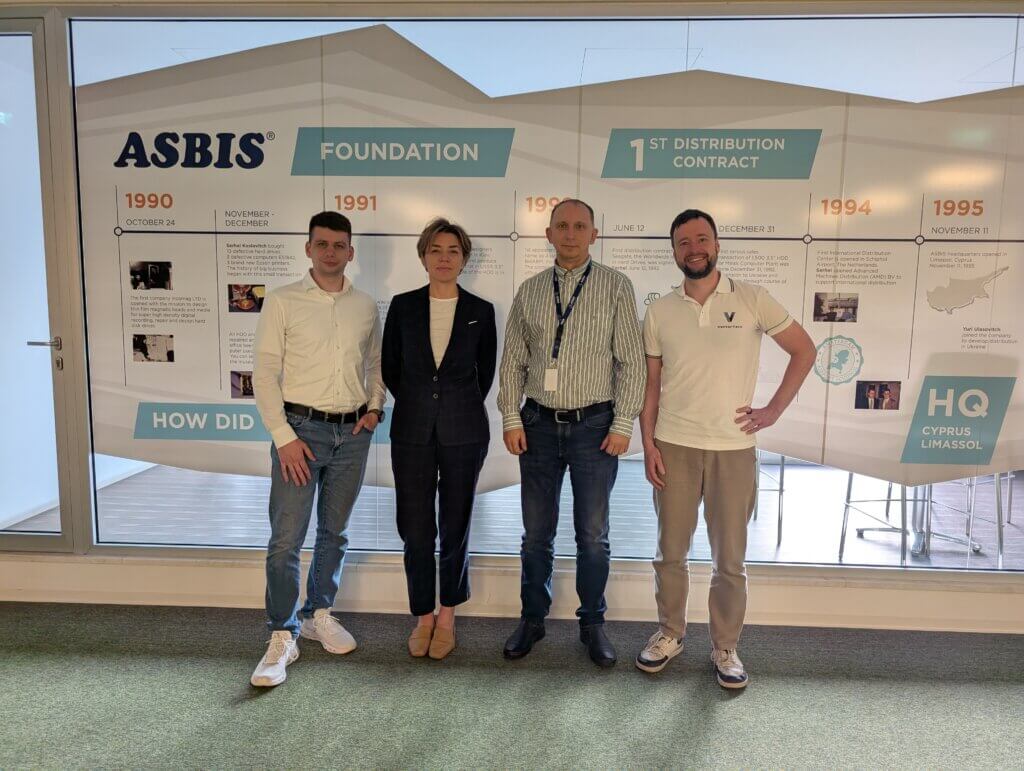
ASBIS office in Cyprus
ASBIS
  • IT distribution, headquartered in Cyprus
  • Subsidiaries in 34 countries
  • 2,200+ employees
  • Sales of about $3.9 billion (2025)

From an in-house ERP to group accounting in Odoo

The in-house ERP could no longer handle accounting across many legal entities. We built a template system in Odoo, connected to the corporate ERP, and replicate it across subsidiaries.

"We especially appreciate the seamless consolidated reporting and the strong performance of the new system."Anna Kaplan, Executive Director, ASBIS

Presented at Odoo Experience 2025. Read the ASBIS case

INEX Group case presented at Odoo Experience 2026
INEX Group
  • Real estate development
  • 20+ legal entities
  • 200+ employees
  • Cyprus, Serbia and the UAE

One source of truth for 20+ entities

Finance, banking and project data lived in separate systems and Excel. We moved the group onto one Odoo database with analytics captured at the source, so profit is now visible for each project and property, not only for the group as a whole.

"Today, our finance team has shifted from collecting numbers to analysis, control, forecasting, and supporting management decisions."Sergey Bagdoyan, CFO, INEX Group

Presented at Odoo Experience 2026. Watch the INEX case

Oleg Kuryan, CEO of VentorTech
VentorTech
  • Odoo implementation company
  • 70 employees
  • 3 legal entities
  • Poland zł, Estonia €, USA $

Own accounting in Odoo since 2016

All financial data from our three companies lands in Odoo and consolidates automatically. Standard Odoo and a few modules of our own tie every line to a department, business unit and cost category. Any figure on the dashboard opens down to the document behind it.

"Every morning I open one P&L for our three companies. If a line is red, I go to the head of that department and ask what happened. We used to wait for someone to pull the numbers together. Now our finance manager spends that time on forecasts and cash planning."Oleg Kuryan, CEO, VentorTech

Want to see how it works live? Request a demo

These are the projects we can name, along with a finance transformation for an international software company; most of our finance work is under NDA. On request, we share a similar case from your industry or country and introduce you to that client's finance team.

Talk to the team behind these projects

We walk you through a comparable case and show how it maps to your entities, currencies and reports.

Get a consultation

How we implement Odoo for a group of companies

We start small, prove the structure on real data, then roll it out across the group.

  1. Discovery and analytic design

    We map your entities, currencies and reports, and agree on the analytic dimensions management needs: business units, projects, regions, cost centers. More about the Odoo discovery phase.

  2. First phase on real data

    We start with the area that hurts most, such as group budgeting or full accounting in one or two entities. Go-live is tied to a date that matters to you, for example the start of the next budget cycle.

  3. Roll-out

    The proven setup is extended to the remaining companies and processes, so each new entity follows the same rules.

  4. Handover

    We train your team to run the system day to day: adding new legal entities, banks and analytic accounts, and adjusting reports as the group grows.

Each phase is estimated and approved on its own. You see one phase working before you commit to the next.

Already running finance in Odoo? If it was set up quickly, on your own or with AI tools, and the numbers do not quite add up, we can give you a second opinion. We check the chart of accounts, intercompany, analytics, bank rules and customizations, including anything built with AI, and tell you what to keep and what to fix. More about the Odoo audit and the audit of AI-built customizations.

Request an audit

Moving from 1C, QuickBooks, Sage or spreadsheets

Groups often come to Odoo from 1C, QuickBooks, Sage, another local system or spreadsheets. As part of our Odoo migration services, we move opening balances, the chart of accounts, partners and the history you need, in phases rather than all at once.

Many groups keep statutory accounting with local accountants in each country, while Odoo runs management accounting and control for the whole group. Others move statutory books into Odoo where a local package exists. Both set-ups run in parallel without conflict.

Standard first, tailored where it matters

Every group has a few rules of its own. Odoo is built to take them on without turning into a custom system.

  • Open code, no black box. Odoo is open source, so every report, field and rule can be adjusted, and your data stays fully accessible.
  • Changes sit on top of the standard. Customizations are separate modules that leave the core untouched. Each one needs migration work when you move to a new Odoo version, so we keep them few and estimate that work in advance.
  • Only what pays off. We cover as much as possible with standard features. During discovery, we run a fit-gap analysis and propose a solution for each gap.
  • The books stay untouched. Management accounting can be reshaped as the group needs, while statutory accounting keeps following its strict legal rules.
VentorTech Odoo finance team
VentorTech team

Odoo finance consultants who understand accounting

VentorTech has worked only with Odoo since 2012. We are an Odoo Gold Partner. We are also an official partner and an active member of the M&A CFO Club in Cyprus, and we run webinars on finance management in Odoo for CFOs. Our consultants combine Odoo configuration with accounting and management reporting, so CFOs talk to people who know what a closing checklist and a consolidated P&L should look like. Our team has completed Odoo's official AI training, and we structure financial data so AI tools can work with it reliably.

We work with groups in Europe, the Middle East and the US, and run projects in English and Russian.

Odoo multi-company accounting: FAQ

Does Odoo eliminate intercompany transactions in consolidated reports?

Yes, with the right setup. Odoo creates the mirrored bill automatically and posts intercompany revenue and expense to dedicated accounts, which the consolidated P&L nets off or shows on a separate line.

Can Odoo consolidate entities with different currencies and charts of accounts?

Yes. Each company keeps its own currency and local chart of accounts. Similar accounts are mapped to each other, so the group report rolls them up correctly, and it converts every company into the currency you choose.

Can Odoo connect to banks in Cyprus?

Yes, several of them. Bank of Cyprus and Alpha Bank are available in Odoo's bank feeds, and we confirm each account when we connect it. If your bank is not supported, there are two options. A small connector can be built, where the harder part is getting the bank's approval to access statements. Or you export a statement file from the bank and import it into Odoo, which reads the transactions and reconciles everything it can match.

Does Odoo support IFRS and local statutory reporting?

Each company keeps its books on its local chart of accounts. Tax reports come from Odoo's localization where one exists for the country. Where it does not, your local accountants prepare them from Odoo data, or we add a custom report. For the group, Odoo builds a combined management report in one currency with intercompany excluded. IFRS consolidation entries, such as eliminating investments against equity or minority interests, are not automated: your team or your auditors post them manually in a separate ledger, so the local books stay untouched.

Can we add new legal entities without a partner?

Yes. A person on your side takes part in the project, learns where each setting lives, and we show them how to add companies, banks and analytic accounts. Our aim is to hand over the knowledge, so your team can configure and extend the system on its own. After go-live, we stay available for support and maintenance.

Can one analytic account be shared by several companies?

Yes. An analytic account that is not tied to a company is available to all of them, so a business unit working through several legal entities reports as one. You can still restrict an account to a single company when needed.

Can a month be closed before cost allocation is known?

Yes. Shared costs can be allocated provisionally, for example with last month's percentages, and re-allocated once the real basis is known. Re-allocation changes only analytic entries, so the books and bank reconciliations stay as they are. Allocation by a changing basis, such as revenue or hours, is not standard in Odoo and is added with a customization.

Can spend requests be approved against the budget?

Yes. A department head raises a spend request against their cost-center budget. The approval route depends on the amount, for example the head of department, then the CFO above €10,000 and the CEO above €30,000. Once approved, the treasurer releases the payment. Approval routes are part of Odoo. Showing the remaining budget to the approver at the moment of approval is a small customization we add on top.

Can we plan and track cash, not only profit?

Yes. Odoo's cash flow statement uses the direct method: receipts and payments split into operating, investing and financing activities. A rolling cash forecast by company, based on due dates of open invoices and bills, is built in Odoo Spreadsheet.

How are statutory and management accounting separated in Odoo?

They are separate by design: journal items hold the books, analytic items hold management dimensions. You can restructure or re-allocate analytics as often as you need without touching posted entries or reconciled banks.

Can Odoo AI answer questions about financial performance?

Yes. Odoo includes AI agents that answer questions in plain language using data from your database, such as the P&L, receivables or cash flow. Questions that span several companies, business units or custom metrics need a well-structured setup and an agent configured for your group.

Can AI explain budget variances in Odoo?

It can analyze budget reports and point to the lines that deviate from plan. Tracing a variance to its cause depends on budgets, analytic plans and source transactions being structured so the AI can follow them. We set this up as part of the implementation.

Where does our financial data go when we use AI?

AI tools connect to Odoo under the access rules you set. You choose the AI provider and connect it with your own key. You can also switch AI on later, after go-live.

What if Odoo lacks a feature our group needs?

It is added with a targeted customization, usually a small module on top of the standard. Typical examples are a custom layout for the cash flow statement, allocation of shared costs by revenue, headcount or hours, and payroll rules for countries without an Odoo payroll package. We scope these during discovery.

What happens when Odoo releases a new version?

Odoo releases a new version once a year. The standard part of your database is upgraded with Odoo's own upgrade service, which is included in the Odoo Enterprise subscription at no extra cost. Each customization needs migration work, so we keep them few and estimate that work before you decide to upgrade. There is no obligation to move to every new version: each version is supported for three years, and we agree on the timing with you.

How long does a multi-company Odoo implementation take?

For a group with standard finance requirements, the first phase usually takes one to three months. The biggest factor is how much time the person leading the project on your side can give it. Large groups with many integrations and deep customization should plan for about six months. Book a consultation, and we will tell you how long it takes in your case.

Why Odoo for a group of companies?

Because consolidation, intercompany, multi-currency and analytic accounting are part of the standard product, and all companies of the group work in one database. Licenses are priced per user, not per module, and the same system can later cover sales, purchasing, projects or HR. A group with several companies needs Odoo's Custom plan. Compared with NetSuite, Dynamics 365 or SAP Business One, or with intercompany and consolidation software bolted onto separate local systems, it is usually less expensive to license and easier to adapt to your own processes.

Can Odoo replace dedicated multi-entity or financial consolidation software?

For many mid-sized groups, yes. Consolidated P&L, intercompany, multi-currency and analytic accounting are part of standard Odoo Accounting, and all entities work in one database. Groups with complex ownership structures and full IFRS consolidation, including minority interests, still post those entries manually or with their auditors, while Odoo runs management reporting for the whole group.


Get an estimate for your group

Tell us how many entities, countries and currencies you run, and what you use for accounting today. After a short questionnaire, we come back with a rough estimate on a call.

Get an estimate for your group

Subscribe to our newsletter

Start your free 7-day trial


You’ll receive an email with a link to download the APK after you confirm the address.
We respect your privacy


Cookie Settings