


| Summary: We specialize in Odoo ERP projects for nutrition, supplements, and wellness brands, and here we share our hands-on experience on why strong ERP systems are essential for such businesses. The article is structured as an industry overview, followed by key ERP requirements, a comparison of ERP options, real-world Odoo case studies, and a concluding perspective on implementation strategy. |
Nutrition and Supplements (aka Nutraceutical) Industry Overview
The nutrition and supplements (aka nutraceutical) industry occupies a unique regulatory niche between food and medicine. It is regulated as a special “dietary supplement” (USA), “functional food,” “quasi-drug” (Asia-Pacific area), or just as foods but with special provisions on nutrient levels, labeling, and health claims (EU) — regimes that differ sharply by jurisdiction, creating fragmented and sometimes contradictory requirements for ingredients, labeling, claims, and market entry.
Understandable pandemic-related demand (e.g., vitamins C, D, and zinc sales surged 20–50% in 2020–2021), e-commerce proliferation, and trends toward personalized, plant-based, and clean-label products – to fill the increased gap likely created by the dip in pharma trust — caused an explosive growth in this category, outpacing pre-pandemic years by roughly 5 times in Europe and 4 times in North America (by CAGR). As per Dietary Supplements Market Analyses Report, “The market is driven by heightened health consciousness, evolving consumer lifestyles, and increased focus on preventive healthcare.”

That combination — regulatory complexity plus explosive demand with opportunities for smaller, nimble businesses to take advantage of the situation — makes compliance, traceability, and flexible channel integration top priority for operations, which in turn puts much pressure on IT automation tools like ERP. For the companies outgrowing their locale, international expansion adds often unexpected functional challenges, especially in supply chain, where in addition to supplier audits, COAs, and variable lead times for specialty ingredients, the operations have to deal with different labeling, compliance, and ingredient approval hurdles.
Let’s discuss a mix of critical processes with functional and regulatory requirements essential (in many cases) for ERP to handle in this field, slightly adjusted for SMBs. Keep in mind that by describing priorities, the focus here is on the sector-specific differentiators above and beyond generic ERP functionality (such as inventory management, accounting, etc.).
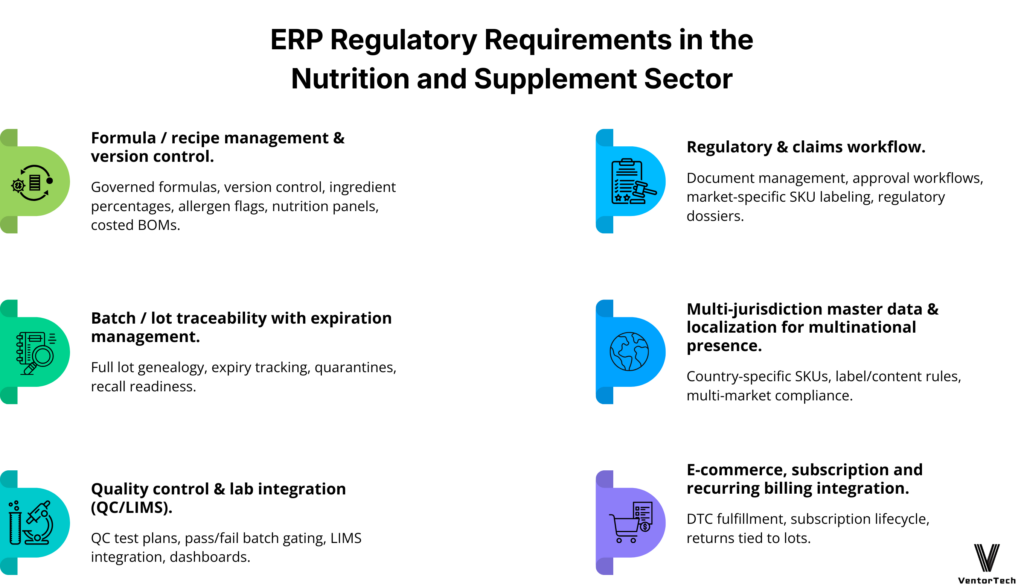
- Formula/recipe management & version control.
Ingredients, active doses, and allowed blends differ by market; formulations are frequently tweaked. ERP should have governed formula management, revision history, calculation of active ingredient percentages, allergen flags, nutrition facts panel generation, costed BOMs for variable batch sizes. - Batch/lot traceability with expiration management.
Recalls, GMP audits, and regulatory inspections require full traceability to lot and sub-lot levels. ERP should hold full lot genealogy, track expiry, and include quarantining flows and recall reports. - Quality control & lab integration (QC/LIMS).
Frequent third-party lab testing, potency, and contaminant testing drive ERP functions to include QC test plans, pass/fail gating for batch release, integration with LIMS/lab partners, and QC dashboards. - Regulatory & claims workflow.
Different evidence thresholds for health claims, pre-market notifications in some regions, and ingredient approvals for novel foods create a need for ERP to have robust document management, approval workflows, tagging of market-specific SKUs/labels, storage of regulatory dossiers, and audit trails. - Multi-jurisdiction master data & localization for multinational presence.
Since one SKU may require different labels, warnings, permitted claims, or even banned ingredients in different countries, ERP needs to manage multi-country product masters, country-specific SKU variants, and automated label/content generation per jurisdiction rules. - E-commerce, subscription, and recurring billing integration.
DTC with subscription is a major growth engine in nutraceuticals. ERP must support frictionless fulfillment, two-way integration with subscription platforms, order orchestration, subscription SKU lifecycle, and returns tied to lots.
ERPs Landscape for Nutraceutical SMBs.
In such an unpredictable and demanding environment, selecting an ERP, designing its implementation, and securing the right partnerships are critical. And for an SMB, often constrained by its financial means, the choice usually lies in between specialized ERPs for nutrition and supplements and a generic, affordable ERP platform with flexible add-on options and prospects of growing with the business and its developing needs.
ERPs from specialty vendors like BatchMaster, Mar-Kov, WhereFour, Deacom, Aptean, and OptiProERP offer systems that are purpose-built for process-based manufacturing in the nutraceutical sector, automating critical processes such as formula/recipe management, batch production and scheduling, lot-level traceability, quality control, and regulatory compliance (e.g., FDA DSHEA, GMP/cGMP). Those vendors can be well-suited for SMBs due to their out-of-the-box tools tailored to nutraceuticals as well as lower implementation complexity compared to enterprise giants like SAP or Oracle.
However, their rigidity — often stemming from fixed architectures optimized for formula-heavy production and lack of core ERP features — can hinder SMBs from navigating rapid shifts in the aforementioned unpredictable but opportunity-rich environment.
What Makes Odoo a Favorable ERP Choice for Small- or Medium-Sized Nutraceutical Companies?
Odoo, an open-source, modular ERP, offers a more generalist approach with high customizability, making it preferable in circumstances of constrained budgets, evolving sales channels, or non-standard workflows, though this system may require initial configuration for nutraceutical specifics.
It is deployed as a suite of 70+ interconnected apps (e.g., Manufacturing, Inventory, CRM), allowing SMBs to activate only necessary modules, such as MRP for recipe scaling or Quality for audits, without overpaying for unused features. Its open-source core enables code-level tweaks via community apps or low-cost developers, fostering scalability as SMBs grow amid the sector’s e-commerce boom.
Odoo’s flexibility shines in hybrid operations, where nutraceutical SMBs blend production with D2C sales or personalization trends accelerating since 2023, with 40% of consumers seeking tailored supplements. But in rigid specialty systems such expansions that often result in costly vendor consultations, where Odoo allows in-house adjustments, significantly cutting adaptation time.
Scenarios and Examples
Here are some down-to-earth examples of real Odoo deployment from nutraceutical firms, illustrating how modularity, add-ons, and dosed customization enabled success stacked (hypothetically) against the known specialty ERP vendor’s strengths and weaknesses.
BatchMaster is known to perform well for steady production of items like vitamins, where it accurately calculates costs based on recipes. However, it is not a full-spectrum ERP that handles all business functions out-of-the-box. Instead, it was created as a manufacturing add-on or extension, which necessitates integration with robust financial/accounting systems like SAP Business One (SAP B1) or QuickBooks to create a complete enterprise solution. In these situations, BatchMaster’s add-on model adds integration fees, ongoing maintenance, and potential data sync issues, all of which inflates costs. Odoo’s integrated ecosystem avoids these issues with a surplus benefit of, for example, building custom connections for online sales data directly into inventory tracking through easily linking an online store to handle large order volumes.
This distinction is illustrated by LeeGroup GmbH, a Swiss producer of high-end supplements. During its post-pandemic expansion, the company faced a challenge: achieving real-time synchronization of a large volume of online sales orders without delays. Our integration enabled them to seamlessly transfer over 600,000 orders from Shopify into Odoo. This successful partnership, with its humble beginning of deploying VentorTech’s mobile app in 2021, is now rolling into a 2025 Odoo v18 upgrade with ongoing consulting and implementation services.
Related service: Odoo version upgrade

Mar-Kov ERP stands out by real-time yield monitoring as a key component of its Manufacturing Execution System (MES), helping to maintain quality standards in products. Yet, it depends on separate add-on software for financial tasks. Odoo addresses this by connecting its accounting and production automatically, providing a foundation for regulatory invoicing and tailored financial workflows that speed up local requirements compliance.
Genius Nutrition S.R.L., a Romanian company specializing in sports supplements, had already implemented Odoo (including its accounting module) before engaging VentorTech for refinements. Since General Nutrition had come across the aforementioned regulatory challenges of the segment, VentorTech customized the e-invoicing module and improved the Shopify Connector to meet Romania’s E-Factura, E-Transport, and SAGA XML electronic billing rules, which ensured stable financial operations and regulatory adherence even amid market ups and downs. This leveraged Odoo’s modularity to resolve prior instabilities without starting over, circumventing the longer setup times required for external connections.
Aptean organizes recipe-based production schedules reliably for ongoing supply operations. But the high price — due to their enterprise focus — can strain small businesses, especially through additional components that inflate costs beyond the base license. Odoo, as an all-in-one modular ERP, bundles most core modules (e.g., manufacturing, inventory, accounting) into flat per-user plans while minimizing add-on needs, with optional expansions from the wide community of developers. Odoo’s structure gives it a significant cost advantage for SMBs, with lower base rates and fewer mandatory add-ons, leading to lower TCO in many cases.
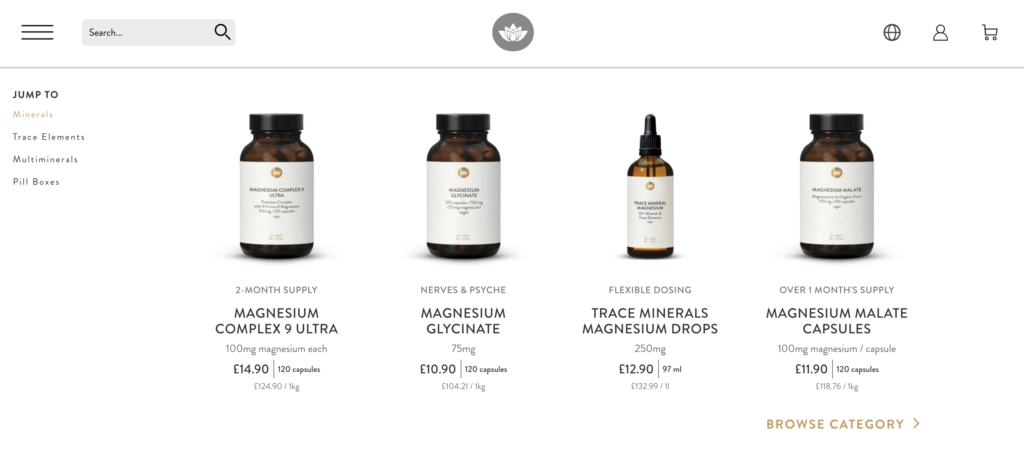
Sunday Natural GmbH, a German producer of pure nutritional products, struggled to distribute a large volume of orders on time. Standard Odoo functionality could not support processing thousands of items per day, especially during critical sales events. To address this, they implemented the Ventor PRO tool for inventory management and made some adjustments to Odoo’s inventory system. As a result, they increased daily order handling from 500–1,000 to 7,000–10,000 items (reaching 15,000 during peak sales events) while simplifying the management of different product versions without being held back by restrictive pre-set formats.
Conclusion
In embracing growth in the dynamic nutraceutical landscape Odoo’s modular architecture stands out for its adaptability. Its open-source foundation empowers businesses to selectively deploy interconnected apps — from inventory and manufacturing to accounting and CRM — tailoring solutions to unique needs without waste or unnecessary rigidity that often comes with specialty or big names ERPs. Yet, unlocking this potential requires a careful approach and strategic collaboration. Successful ERP implementations hinge on partnerships with experienced consultants who can bridge the gap between tools and real-world workflows, ensure meaningful and optimal customization, mitigate common pitfalls, and enable smooth rollouts that align with business goals while maximizing ROI.
Optimize Your Supplement & Nutrition Business with Odoo ERP
Recommended articles:
- What Is ERP ROI and Why Is It Important?
- The True Cost of Odoo ERP: Pricing and Ownership Insights
- Key Performance Indicators (KPIs) and their Role in Successful ERP Implementation
- Odoo Implementation Steps

----------------------------------------------------------------------
Education: MSc, MBA
----------------------------------------------------------------------
Experience:
Director, Research & AdvisoryDirector, Research & Advisory
Info-Tech Research Group
Global IT Director, CIOGlobal IT Director, CIO
Napoleon Group of Companies
----------------------------------------------------------------------
Will do any work for SpaceX for free


0 Comments