


| Summary: Companies have very different experiences with Odoo. Some are highly satisfied with how it fits their business needs, while others describe it as the worst platform and an awful experience. In our new article, we dive deeper into the most common complaints about Odoo, including support issues, unexpected costs, DIY implementation challenges, and customization problems. Using real user examples, we analyze the root causes behind these frustrations and explain what businesses can do to avoid similar mistakes. |
We researched user complaints about Odoo across multiple review platforms, found patterns, and explored why the system works for so many companies but fails for others. The article highlights four key misconceptions that consistently appear in unsuccessful implementations, supported by real examples and references.
After combing through Reddit threads, forum posts, BBB complaints, and ERP review platforms, certain patterns emerge about Odoo ERP. Not much unique is said about Odoo itself, but there is a common pattern across the ERP niche (often called Tier 3) that Odoo and other software programs like it occupy. People complaining about the system should really be asking one question: Why does Odoo — as an application and as a company behind it — work so well for many businesses but failed to fully work for mine? If it is really “bad” software, then why is it bad for some but not for all?
And while answers to specific questions could be complicated and definitely pointing to things that Odoo SA should work on, the ready answer to those complaints rests with users’ own failures in the software’s implementation.
A Toyota Corolla costs about $25,000, and a Lexus LS costs $80,000, but they both require a driver’s license, insurance, regular maintenance, and someone who knows how to drive. The price difference does not change those basic fundamentals, but judging by the complaints online, some think that their Corolla (Odoo) does not even need gas to run!
Odoo pricing starts at around $25 per user per month. Compare that to SAP S/4HANA, where you’re looking at enterprise licensing that could run $250K–$10M+ just for implementation. Naturally, when people see Odoo pricing, they think, “Great! An affordable ERP that I can probably set up myself over a weekend on that retired desktop computer.”
Odoo’s lower price point creates a dangerous misconception that implementation will be equally simple. Spoiler alert — it’s not!
One Trustpilot reviewer captured this perfectly: “This thing is a whole new level in terms of complexity and options. The UX is unintuitive, it’s about 20,000x more complicated than it needs to be.” After two years of struggling, they still had no idea what they were doing. The problem? They treated setup like installing Microsoft Office (which can be a doozy too, by the way!), while not considering it to be a professional process of implementing an enterprise resource planning system.
In treating ERP implementation like regular home software installation, some people run into big implementation problems. These are usually the same people who are not mapping their business processes, documenting requirements, or following any structured methodology, which includes that they do not reach out for the advice of an experienced ERP implementation professional.
#1 Support Complaint: Looking in the Wrong Place
Inadequate customer support ranks the highest, with users frequently describing this as fragmented and sales-oriented rather than solution-focused. One clear example comes from a Reddit post in which marketer complained about outdated tutorials and unresponsive account managers: “All their tutorials and instructions are 5+ years old and don’t match the current version… The only ‘customer support’ I have is a business manager who I literally have to pay just to speak with.” And that was in regard to “making the phone number clickable on the desktop footer” — a simple frontend customization.
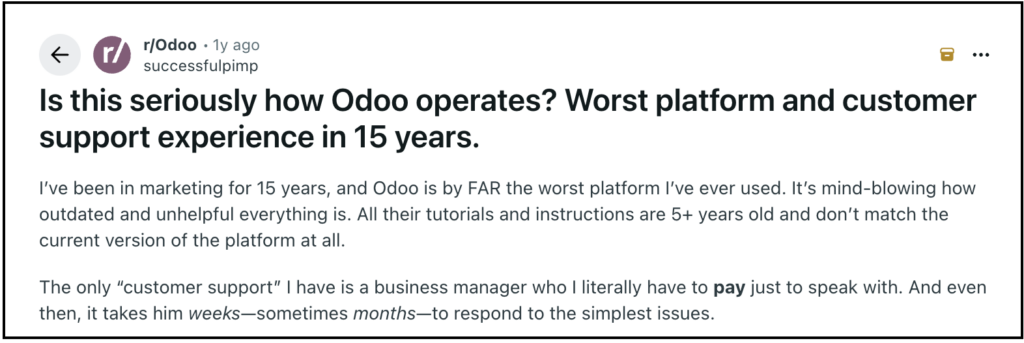
One of this complaint’s responses set things straight: “The whole goal of Odoo support is to give you resources so that you are able to make the configurations yourself and learn from it. It is not a support where you tell them what to do and then they do it.”
Indeed, why would you ask a total stranger to mess with your system? Severe organizational issues usually lurk behind innocent questions like “Can we have this button, please…” which when “fixed” would snowball into confusion, productivity loss, and more button requests until someone finally says: “Stop! Let’s look at the whole process.”
Throwing money at Odoo support and expecting the software to magically work is a bad approach. Another complaint on BBB read, “I paid $8,170 for a 50 h. success pack. Odoo has terrible business practices.” Then, the complainer clearly misunderstood Odoo’s response: “Successful implementation projects require a dedicated and empowered representative from the client’s organization to oversee key aspects of the process.” Yes, it’s a mutual project, a marriage in between technology and your business processes — not a paid one-night stand.
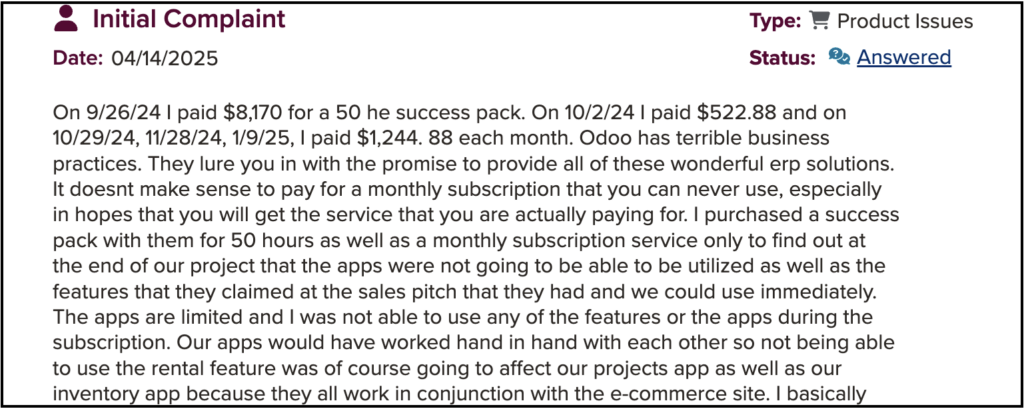
When it comes to implementations, Odoo’s “Success Pack” and the BSA (Business Success Analyst) assignment are major sources of frustration, and rightfully so — they are marketed in a way that can be easily misconstrued as full ERP implementation consulting services. Still, Odoo SA officially positions Success Packs as knowledge transfer and coaching rather than hands-on project delivery. The Success Pack enables success rather than delivers it — that’s a big difference! While this mismatch creates disappointment, it should not be used as an excuse to avoid proper evaluation of the support partnership or at least thinking about how capable a junior IT guy from India might be in dealing with the Canadian tax system.
Odoo’s business model relies heavily on the implementation partner ecosystem. This isn’t a bug — it’s a feature.
If you puncture a tire, you don’t call Toyota’s corporate helpline for service — you work with your dealership and roadside assistance, or you learn how to install the doughnut yourself.
Looking for a Trusted Odoo Partner to Implement Odoo Flawlessly?
What users could have done:
- Understand the support structure before purchasing
- Engage certified implementation partners from the beginning, not rely on direct vendor support
- Properly vet partners for experience, industry knowledge, completed implementation case stories, reviews, certifications, and support capabilities
Related Service: Odoo Consulting and Configuration#2 The DIY Disaster: “20,000x More Complicated Than It Needs to Be”
A user regretting their implementation attempt shared: “The problem is partially Odoo as company who give false impression that anybody can self-manage the software, which is ridiculous. It takes years of experience and knowledge to handle ERP implementations.” Similarly, a self-implementer noted the daunting curve: “Yes, it is a major learning curve. But if you have some time, it’s totally worth it… API totally blows and makes no sense, but you can figure it out from the UI.”

What is the root cause of this problem?
Underestimating ERP complexity entirely. Odoo, with its accessible pricing and DIY marketing claims, creates the illusion that implementation should be simple. But ERP complexity remains constant regardless of the price point. You’re still dealing with:
- Process standardization across departments
- Data governance and migration with quality management
- Organizational change management
- Integration with existing systems
- User training and adoption
What users could have done differently:
- Follow structured ERP implementation methodology
- Allow an adequate timeline (e.g., 6 — 12 months vs. 2 — 3 months)
- Engage implementation partners early, not mid-project after discovering problems
In looking at the overall situation, let’s consider: Would you buy a car, whether it be Corolla or Lexus LS, based on a TV commercial alone, or would you at least have a test drive? It’s not incorrect to claim that Odoo is DIY, but is this the smartest way to do it?
#3 When “Open Source and Affordable” Becomes Expensive
This one might sound similar to #1 and #2, but it’s not the same, as it considers the price tag and functionality as opposed to support misuse, deficiencies, and unexpected implementation complexities. Odoo’s free edition draws you in, but enterprise add-ons and support pile up, much like budget car packages escalate closer to premium expenses.
One user expressed regret: “That tax service was going to cost us $5000 a month!” after sales overlooked details. Another felt baited: “Odoo markets itself as ‘All your business on one platform’… potentially resulting in unpredictable and substantial costs.” Ah! The marketing… looks like it’s working.
But here’s the thing:
These aren’t really pricing problems; they’re planning and false expectation problems.
What these users should have done:
- Conducted a thorough requirements analysis before purchasing
- Engaged qualified partners during evaluation to understand true total cost of ownership
- Budgeted for the complete implementation — customization, data migration, training, etc. — and not just licensing
- Createed a detailed gap analysis between Odoo Community and Enterprise features and what would still be left to do through add-ons and customizations
Related Service: Odoo Discovery Phase#4 The Customization Trap: When “Flexibility” Becomes a Liability
If there’s one complaint that captures the Odoo paradox perfectly, it’s customization. The flexibility that attracts businesses becomes their worst nightmare.
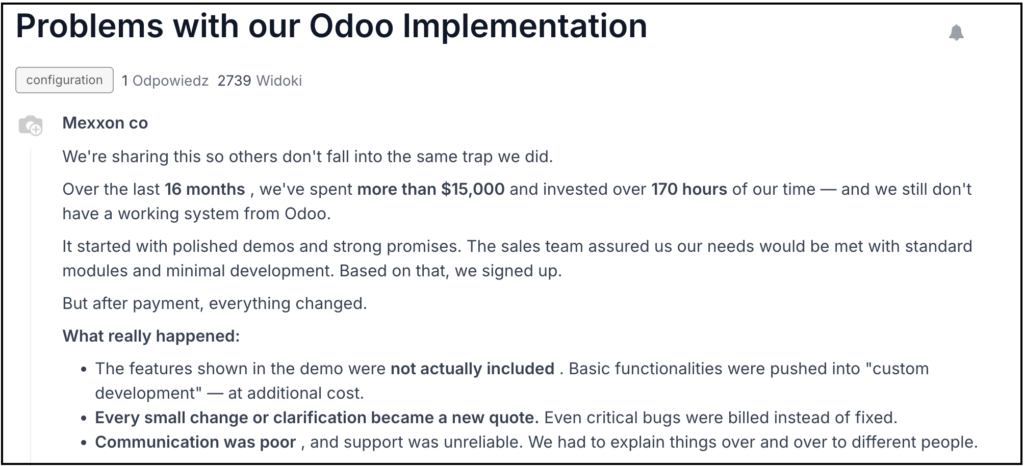
As one user documented on the Odoo forums: “Basic functionalities were pushed into ‘custom development’ – at additional cost. Every small change or clarification became a new quote. Even critical bugs were billed instead of fixed.” But the revealing part lies in the main complaint itself: “The sales team assured us our needs would be met with standard modules and minimal development. Based on that, we signed up.” They purchased based on a sales pitch rather than verification — the equivalent of buying a car without a test drive. That’s not vendor deception; that’s procurement negligence.
Then comes the upgrade nightmare. A photographer shared their company’s experience with Odoo 18: “The moment I upgraded to Odoo 18, everything went haywire. My website’s entire format was changed, undoing months of hard work on design…” Another client highlighted upgrade risks but less pessimistically: “It could happen, when upgrading the Odoo version, that the customization stops working, but the fixes are very often pretty simple, just changing a variable here and there.”
Upgrading often requires adapting customizations, which can come with a hefty price tag, depending on how professionally the original programming was done to handle the upgrades among other things. Eventually companies that don’t exercise due diligence realize they’re trapped and prefer to stay stranded on outdated Odoo versions for many years, because fixing bad customization feels more expensive than living with it, even keeping in mind that they need to pay 25% more for their Odoo Enterprise contract.
Related Service: Odoo UpgradeThe root cause?
Confusing configuration (using built-in options) with customization (changing underlying code) — while mindlessly executing on the latter. For example, with both Lexus or Corolla, you can configure seat settings. Lexus offers more options, of course… yet you don’t modify the engine on either vehicle. Here’s where this analogy breaks down: Odoo’s flexibility allows engine modifications but it doesn’t mean you should or at least not on your own.
For comparison, SAP heavily discourages customization of its software, requires strict governance, and maintains upgrade paths. In contrast, Odoo promotes flexibility as a selling point, has little governance enforcement, and puts the upgrade burden on customers. The result? Companies attracted to Odoo because of customization flexibility then complain when that flexibility creates technical debt.
The core of the issue: businesses want ERP systems that work exactly like their current processes, but ERP implementation is supposed to standardize and improve processes, not to continue or maintain dysfunction.
What users could have done:
- Review and revise business process subject to ERP automation
- Exhaust configuration options first before customizing
- Implement customization governance — establish a review board to approve changes and distinguish between must-have (regulatory, compliance) and nice-to-have customizations
- Work with partners who push back on unnecessary customizations
Related Service: Odoo DevelopmentGood implementation partners challenge customization requests and design upgrade-safe solutions. Poor partners say ‘yes’ to everything, because such a response increases billing hours; then they simply disappear when upgrade problems arise.
Revealing insight comes from discussions about the varying quality of implementation partners: “Not all Odoo partners guide clients properly – some might oversell or underestimate complexity. Companies should consult with senior Odoo consultants first to get realistic costs and timelines,” notes one user, before adding: “If you don’t know what you are doing, you can waste a lot of time and money.”
But isn’t that true for not just Odoo — and not even just for ERP?
In Conclusion
While many other complaint areas exist (e.g., performance issues, scalability, challenges with end-user adoption, poor documentation), they most often overlap with what we have covered in this article — except for, maybe, poor documentation.
Ultimately, we found the same story cycle in so many Odoo complaints:
Both Lexus or Corolla will get you where you need to go, but neither will drive itself. Odoo is an excellent ERP system that delivers tremendous value at accessible price points. But value requires investment — not just financial, but in time, planning, expertise, and organizational commitment. Companies that understand this succeed. Those that don’t become cautionary tales in forums, contributing to the next wave of complaints that ultimately say more about implementation discipline than they do about software quality or its vendor.
If Odoo isn’t Working the Way Your Business Needs,
It’s Time for Professional Help!
Recommended articles:
- Will your Odoo Enterprise contract be surcharged 25% in April? Tricky cases explained…
- How to Calculate Odoo Workers for Demanding Systems
- Odoo Implementation Steps
- Odoo Access Rights Structure
- AI Order Processing in Odoo
- Odoo EDI Integration
- Key Performance Indicators (KPIs) and their Role in Successful ERP Implementation
- 10 most common questions to the official Odoo partner

----------------------------------------------------------------------
Education: MSc, MBA
----------------------------------------------------------------------
Experience:
Director, Research & AdvisoryDirector, Research & Advisory
Info-Tech Research Group
Global IT Director, CIOGlobal IT Director, CIO
Napoleon Group of Companies
----------------------------------------------------------------------
Will do any work for SpaceX for free


0 Comments