

| Summary: The article explains when a company truly needs to switch its Odoo implementation partner. It outlines the warning signs that show a change may be necessary, the risks involved in switching partners, how to make the transition as smooth as possible, what to look for in a new partner, and how VentorTech can help rescue a troubled Odoo project. |
An Odoo ERP implementation is not a software installationn — it is a strategic business transformation. When that transformation stalls, it feels natural to blame the platform and its vendor. In reality, the culprit is almost always an implementation approach that had not been managed well by the partner, the internal planning process, or both. Switching partners mid-project is usually a painful and often politically charged decision tending to happen in a snap moment with emotions rising and heads rolling, all of which makes things worse.
Related Success Story: Odoo for FieldBee: IoT Manufacturer of Agriculture MachinesThis article walks through the warning signs to prevent that “snap moment” when the relationship is degrading, the risks and mechanics of making a change, and a guideline for selecting a new team that is set to deliver where the previous one failed. This guidance draws on established ERP implementation frameworks applying them specifically to the Odoo ecosystem.
When is it time to switch?
Not every frustration warrants a partner change. Technical hiccups or miscommunication are normal friction in any complex project. The decision to switch should be driven by persistent, systemic failures — not by isolated incidents.
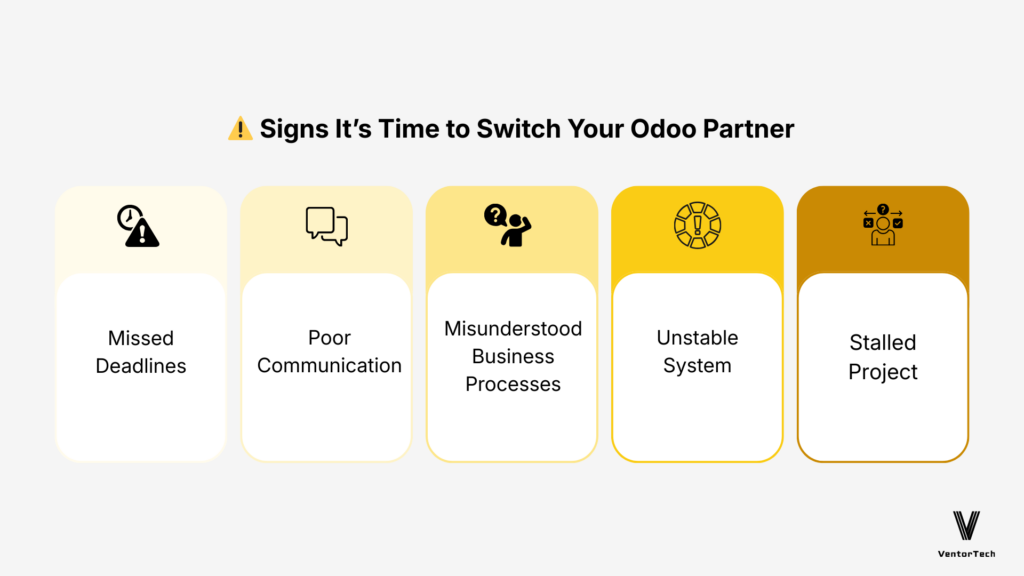
- Deadlines are consistently missed with no revised timeline or explanation. Chronic slippage signals either a lack of project discipline or deliberate accountability avoidance.
- Communication has gone dark. Weekly status reports have stopped or become meaningless. Emails go unanswered. Your team is left guessing about project status.
- Your business processes are being misunderstood or ignored. The partner builds on what they know, not on what you need. Customizations keep piling up, because the underlying workflows were never properly understood, let alone reengineered.
- The system is unstable. Bugs are recurring, and issues that were reported as ‘resolved’ keep resurfacing.
- The project has stalled entirely. Work has been “in progress” for months. There is no visible forward momentum and no escalation path.
Related Success Story: How a UAE Auto Parts Retailer Accelerated Growth With OdooIf several of these apply, then the relationship has likely passed the point of recovery. The longer a troubled project continues with the wrong partner, the deeper the technical debt and the harder the eventual rescue becomes.
Why do Odoo projects fail in the first place?
While all the aforementioned systemic failures are fairly obvious and can be easily “googled” from other sources that tout ERP implementation advice, the following aspect isn’t clearly articulated: introspection. Understanding the actual causes of what’s stalling your ERP project, as opposed to shifting the blame to your partner, is essential before any partner transition. Otherwise, the same mistakes are likely to repeat with a new team.
Your ERP implementation consultant might be simply cornered by your unclear requirements, unreasonable expectations, or the lack of engaged project resources. It does not excuse the consultant from going into the stealth mode, because a good ERP implementation partner should preemptively advise properly in order to avoid those situations in the first place. But without introspection — that is, analyzing comprehensively why your Odoo implementation is in trouble — merely scapegoating unsatisfactory results won’t do much good in going forward.
The most common culprits in Odoo implementations are not unique to Odoo — they reflect well documented patterns across the ERP industry.
No proper discovery or planning phase. Organizations jump into ERP deployment without mapping current processes, defining success metrics, or scoping realistic timelines. Herein is the single largest risk factor: If the project has no criteria for success, then it can never become successful.
Related Service: Odoo Discovery PhaseOver-customization without justification. Odoo’s flexibility is a double-edged sword. Partners who say ‘yes’ to every customization request — regardless of whether standard configuration with some process re-engineering would suffice — are creating technical debt that compounds with every upgrade. Good partners push back and probe; poor partners bill more hours.
Related Service: Odoo Consulting and ConfigurationNo dedicated project manager or accountability structure (i.e., project governances). A project manager is not simply a liaison between teams. They own the timeline, manage scope, and escalate risks. Without one, decisions drift, budgets inflate, and no one owns the outcome. And the best project manager in the world won’t do much without a defined and enacted accountability structure.
Developers with no ERP experience. Technical skill alone is insufficient. A developer who understands only coding but not operations will inevitably produce solutions that automate poorly designed business processes, thus only exacerbating what was meant to be fixed.
Missing documentation and test coverage. This is perhaps the most damaging failure mode for a future partner transition. When the outgoing team leaves no documentation of what was built, why it was built, and how it was tested, the incoming team is effectively starting blind.
The risks of switching Odoo partners
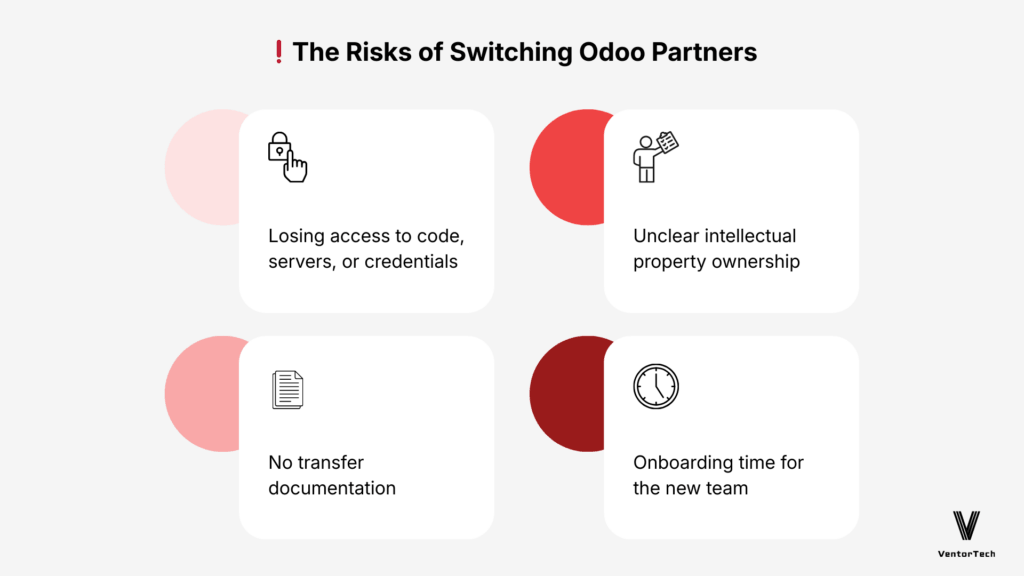
Switching partners without a plan can cause more damage than the problems this action was meant to solve. The key risks need to be identified and actively managed before the transition begins:
- Losing access to code, servers, or credentials. If the outgoing partner controls hosting or repository access and is uncooperative, critical assets can become inaccessible.
- No transfer documentation. Without records of what was configured, customized, or integrated, the new partner must reverse-engineer the system — a time-consuming and error-prone process.
- Unclear intellectual property ownership. If contracts did not explicitly assign ownership of custom modules or code to your organization, legal disputes can delay or derail the transition.
- Onboarding time for the new team. Even the most skilled partner needs time to understand your system, your data, and your business context. Rushing this phase leads to well-intentioned mistakes.
How to secure a smooth transition
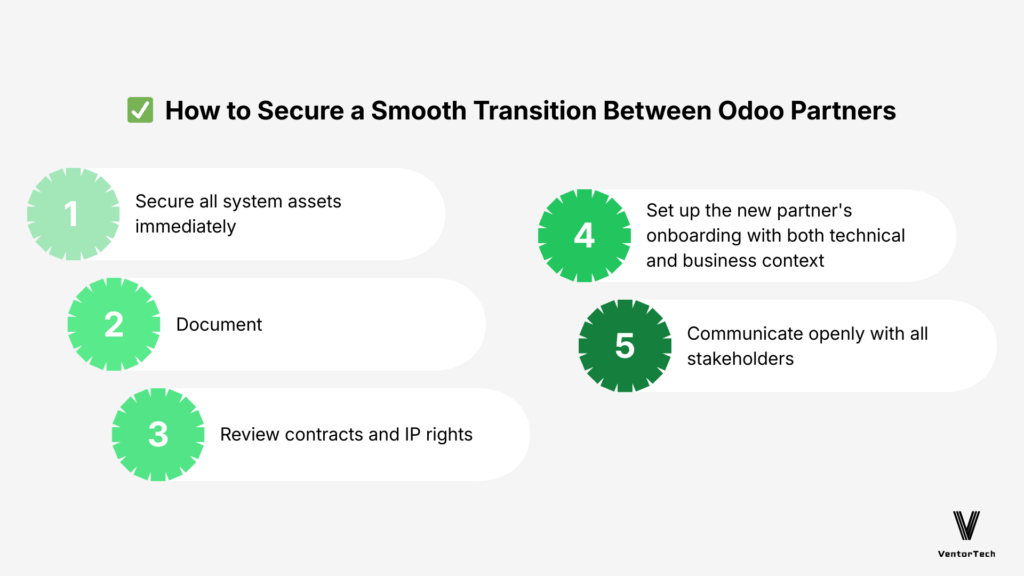
Once the transition decision is made, the following prepares your environment to be more suitable for the new consultant’s adoption:
- Secure all system assets immediately. Request full database backups, all custom code repositories, hosting credentials, and any integration configuration files. Do not wait until the outgoing partner is formally off-boarded to begin this process.
- Document. Catalog every active module, each customization, every open issue, and each pending deliverable. This is your baseline — without it, you cannot define what needs to be fixed.
- Review contracts and IP rights. Engage legal counsel if needed. Confirm that all custom development belongs to your organization and that there are no contractual barriers to engaging a new partner.
- Set up the new partner’s onboarding with both technical and business context. The new team needs to understand not just the code but also the business processes it serves. Provide stakeholder access, process documentation, and dedicated time for discovery.
- Communicate openly with all stakeholders. Internal teams, department heads, and end users all need to understand that a change is happening, why it is happening, and what to expect during the transition period.
What to look for in a new partner
Partner selection is at least as important as technology selection — and arguably more so. “Choosing the Right Odoo Consultant: A Comprehensive Guide” dives into the subject comprehensively, but here’s a snippet from it with a focus on a rescue or transition:
- Deep technical and functional expertise — not just one or the other. Both technical skills and business processes understanding capabilities need to be present and balanced.
- Understanding project management as a discipline. Project management is not the same as resource coordination or relationship management. A project manager is someone, preferably in a neutral position, who owns the delivery timeline, manages scope, and escalates risks without hesitation.
- Transparent communication and regular reporting. Regular status updates, clear milestone definitions, and an honest assessment of what is working and what is not. Transparency is not a ‘nice to have’—it is the single strongest predictor of a healthy partner relationship.
- A mindset of fixing, not blaming. The new partner will inherit a messy situation. A team that spends its energy criticizing the previous partner’s work is a group that is not focused on your outcome.
- Proven rescue and transition experience. Not every partner has stepped into a failing project mid-stream. This is a different skill set than vanilla implementation. That same article referred to above offers a simple list of “10 Questions to Ask Before Signing with a New Partner”. One that should be added to the list, as #11, is: “How will you manage the handover from the previous partner?” Ask for specific examples.
How VentorTech handles rescue projects
VentorTech is an Odoo-exclusive partner with over a decade of rescue and recovery experience. Our approach is as a concrete example of an answer to that question #11.
Conduct initial audit covering both code and business logic. Before any changes are made, VentorTech conducts a deep-dive technical and functional review of the existing system ranging from code quality and infrastructure to business workflows and ERP budgets. Before writing a single line of code, the goal is to understand not just what is wrong, but why it went wrong, which directly prevents the new team from repeating the same patterns.
Related Service: Odoo AuditRedefine your objectives and KPIs. Over 50% of organizations cannot quantify cost recovery on ERP projects, and a key reason is that success metrics were never properly established. VentorTech’s advice is to use this transition as the moment to define what “done” actually looks like with measurable, time-bound targets to which both you and your new partner can be held accountable.
Create a tailored action plan targeting fixes, process improvements, or full relaunch. Not every rescue requires rebuilding from scratch. The action plan distinguishes between what can be stabilized quickly, what needs process-level optimization, and what — in rare cases — is more cost-effective to rebuild than to repair.
Establish a governance model. Define roles, decision rights, escalation paths, and review cadences before work begins. A governance charter is not bureaucracy — it is the structure that keeps a complex project on track and prevents the accountability diffusion that caused the original failure. A stalled manufacturing implementation presents entirely different challenges than might be seen in a broken distribution or e-commerce setup. VentorTech has rescue experience spanning multiple verticals — manufacturing, wholesale, retail, healthcare & pharma — making our professional team less likely to be surprised by what we find.
Related Service: Odoo RescueOur report a 100% go-live rate on revived projects and zero production breaks post-launch, typically resolving up to 80% of major problems within the first 2–4 weeks across our case portfolio, representing outcome-based metrics that a serious rescue evaluation should demand.
Contact VentorTech to Rescue Your Odoo Project.
Final thoughts
An ERP system is meant to be the operational backbone of your business. When the partner responsible for building that backbone is not performing, the right move is not to wait and hope but to choose an effective team that specializes in fixing what others could not deliver. Replacing your Odoo implementation partner is an act of strategic decision-making. The earlier the switch happens, the less ground is lost. But speed must be balanced with discipline — a hasty transition to the wrong partner simply means repeating the problem. A competent partner can help you plan and scale for your transition to a successful business operations outcome.
Recommended articles:
- Why Odoo Works for Thousands but Failed for You? The Hidden Truth Behind Odoo Complaints
- Will your Odoo Enterprise contract be surcharged 25% in April? Tricky cases explained…
- How to Calculate Odoo Workers for Demanding Systems
- Odoo Implementation Steps
- Odoo Access Rights Structure
- AI Order Processing in Odoo
- Odoo EDI Integration
- Key Performance Indicators (KPIs) and their Role in Successful ERP Implementation
- 10 most common questions to the official Odoo partner